John Lewis Quotes
The scars of racism still remain deeply imbedded in America.
John Lewis, U. S. Congressman (Democrat, GA), Speech, 50th Anniversary of the March on Washington, Lincoln Memorial, August 28, 2013
Sourced by: Eigen's Political and Historical Quotations

Vladimir Lenin. In their quest for world revolution, the Russian Communists had more problems with arguments in the United States whose reforms and economy had produced a very high standard of living. They knew that to effect a revolution, they had to reach the middle class and the intellectuals. They had little economically to attack America with but they were able to attack the United States morally. Even though segregation was legal in America at that time, many Americans thought it immoral. Most of the rest of the world did also. So that was one of the attack points. Since the communists opposed U. S. racial segregation, many Southern segregationists used a perverted logic and accused everyone who opposed segregation of being a communist. In addition to racial segregation, the Communists attacked other forms of discrimination such as anti-Catholic, anti-Asian, and anti-Semitic (See {638737} ) behavior.


Christian had just briefed the President about the riots in many cities after the assassination of Martin Luther King. Christian had expressed surprise that the Blacks were so violent.


Booth was the younger son of a very prominent Northern family of actors. His older brother was considered the greatest American actor, and the rest of the family were abolitionists and vehement Union supporters. They found young John’s views reprehensible.

In that year he resigned from the War Department in protest of the discrimination and racism in the armed forces.

His solution was not to change the prejudice or improve the opportunity for Blacks but to have complete separation of the races. See {625687}.


Johnson was the first Black man who won the heavyweight championship at a time when racism in America was rampant. Many whites referred to Jeffries as “The Great White Hope” who would take the champion back for the whites. He didn’t and was beaten badly.

This was a quotation from Roof's twisted confession of the fact that he walked into a black church that was holding a Bible Study Class, and gunned down 9 religious people studing the Bible. His "justification" was based on totally false "facts" but at the time many people--especially those and the extremes of political ideology simply chose the fact that supported their narrative and world vie without regard to veracity. The overwhelming majority of whites who are murdered in America are murdered by other whites and usually by people whey knew. Most rapes in the United States are committed by Whites, not Blacks, Of the Black committed rapes, most of the victims were also Black. Large proportions of the American populace believe that the Black cntribution to crime against whites is very much larger than it reall is. Of the whites who believe this, a tiny few become white supremicists and only some of those act out and commit any physical violance. However the few succetable people like Roof have heard these falsehoods so ofteh that tney not only beleive it si try but they believe taht they must do something lest the problem get worse. Of course, even if Blacks were committing all these crimes against whites, it takes a spcially sociopahic mind to believe that by killing Bible-studying, deeply religious, Christian Blacks, they will somehow stop violent Black crime.

This quote illustrates the Southern segregationist view in the Jim Crow South.


The president was commenting on a Donald Trump campaign statement that African American were in the worst shape in history when the reality was just the opposite

Some whites opposed Slavery and new slave states, not becasue of any sympathy with Negroes or concern for the immorality of slavery, but becasue slavery made it difficult for the working white man to thrive.


This classic quotation illustrates several things. First, the degree of racism that existed in 1944 in West Virginia. Second, not how young Robert Byrd immediately leaped from the possibility of integrating our fighting forces to interracial sex. That has been typical of white racism in America—a preoccupation with race and sex. Last, Byrd who became a member of the KKK, completely changed his mind over the year and ended up supporting the things that, as a youth were worse than the demise of the nation. He matured and grew on the race issue as much of the country did and ended as a strong supporter of equality and civil rights—including affirmative action.

Smith, an extreme racist, was so rabid that MacGregor was supporting the Civil Rights Bill, he followed him off the House floor to make this statement. MacGregor jokingly told Smith that he was wrong. He had 17 Negroes in his District.


Moynihan was an Assistant Secretary of Labor at the time. At the time politicians did not overtly discuss the racism that had, did then, and still does permeate the American culture. Segregation had just been made illegal but was still rampant. Many whites were highly insulted by this paper. Most Blacks were outraged at Moynihan's general thesis. So the report offended many.

Scott was then the Special Advisor on Negro Affairs to the Secretary of War in the Woodrrow Wilson administration. Wilaon hs commited U. S. Troops to fight oversease to "make the world safe for democracy", but many blacks and whites also saw gross hypocricy in asking Negores to fight for a Jim Crow, segregated America. See the related quotation 644805. Scott was also the major aide to Booker T, Washington, one of the leading Negro educators but a very pliable man on equal rights for the Blacks. The problem for the administration was much greater than that of WWII where the president was seen as very sympathetic to Blacks while Wilson was himself a racist. And in WWII the fight against the Nazis was a fight agaisnt racial supremacy. So this quotation and Scott's role was very important to the administration.

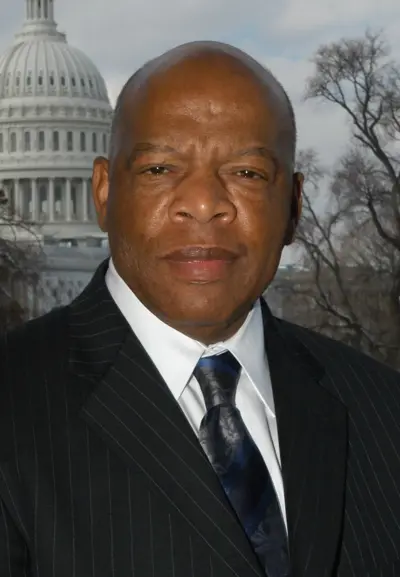
John Robert Lewis was an American politician, statesman, and civil rights activist and leader who served in the United States House of Representatives for Georgia's 5th congressional district from 1987 until his death in 2020. He was the chairman of the Student Nonviolent Coordinating Committee (SNCC) from 1963 to 1966.
