Douglas MacArthur Quotes
Negroes are not qualified to be integrated within his command. When I find them qualified, they will be integrated.
Perhaps there is no more dramatic quotation illustrating MacArthur’s arrogance where his own views and decisions should obviously prevail regardless of the policies of his superiors and his commander-in-chief. The army had been officially integrated by President Truman, The reality was that the general honestly believed that he had no superiors among the military, that civilians should not control the military, and in any event that the President—Truman—was not fit to be Commander-in-Chief.
Douglas MacArthur, 1880-1964, General of the U. S. Army and Supreme Commander of the U. N. forces in Korea, Chief of Allied Occupation Forces in Japan, Remark to Thurgood Marshall, Korea, 1950
Sourced by: Eigen's Political and Historical Quotations

MacArthur was discussing his implementation of women’s suffrage in post World War II Japan. He was told by one of his staff that the Japanese men wouldn't like it: Ironically, the General was a great believer in civil rights for women (he had a very strong and powerful mother) yet he was an inveterate racist when it came to Blacks. See {605734} .

Booth was the younger son of a very prominent Northern family of actors. His older brother was considered the greatest American actor, and the rest of the family were abolitionists and vehement Union supporters. They found young John’s views reprehensible.


Negro volunteers were actually preferred under the theory that their ancestry made them more immune to malaria and other tropical diseases in Cuba.


Vladimir Lenin. In their quest for world revolution, the Russian Communists had more problems with arguments in the United States whose reforms and economy had produced a very high standard of living. They knew that to effect a revolution, they had to reach the middle class and the intellectuals. They had little economically to attack America with but they were able to attack the United States morally. Even though segregation was legal in America at that time, many Americans thought it immoral. Most of the rest of the world did also. So that was one of the attack points. Since the communists opposed U. S. racial segregation, many Southern segregationists used a perverted logic and accused everyone who opposed segregation of being a communist. In addition to racial segregation, the Communists attacked other forms of discrimination such as anti-Catholic, anti-Asian, and anti-Semitic (See {638737} ) behavior.


Incredibly enough, after the Civil War and emancipation, most Virginia leaders opposed any form of rights for Blacks with one of the major reasons being that they were ignorant and uneducated. It was actually a crime to teach even a free Black to read.

Sumner would later become a Senator. However over a century before Brown v. Board of Education finally outlawed segregated schools, Sumner made one of the basic legal arguments that was involved in the case.


When passed, the Social Security Act did not cover domestic or agricultural workers. But these were the two occupations that between employed over half of all African Americans. The Black labor leaders like A. Phillip Randolph, supported the Act as their union membership was covered. The Congress, although controlled by the Democrats had the albatross of the "Solid South" which would obstruct anything that would strengthen the Negro. The strategy the President Roosevelt and his new dealers adopted was to institutionalize Social Security for the majority of American workers and then bring in the occupations and groups that had originally been excluded. And this is what they did however, enforcement of Social Security coverage with individual domestic workers was still a problem in the 21st century.


Billy Sunday was the most famous preacher of the day. Unlike the vast majority of white preachers, he not only preached to black audiences but exuded an atmosphere of friendliness and comfort around Blacks that amazed most. Most Black leaders thought Sunday was very good for race relations, but there were some critics like Grimke. Sunday was castigated by many racist whites for preaching to Blacks, but he did not go as far as to condemn or preach against racism and the discrimination of the day and he would not preach to an integrated audience. See {585416} for another critique.


Newsletter of the United Sons of Confederate Veterans

Captain W.W. Polk, commanding the Coast Guard revenue cutter Florida, wrote Treasury Secretary asking permission to employ a young Negro on board. Existing regulations prohibited such. The Negro in question was a free Black born in New York who was an “expert sailor for his age and competent to the duty of a boy of the first class.” Polk had hired the boy as a servant after he had worked at sea for another Captain. Good seamen were hard to come by, decision was extremely contentious. Ingham “compromised” by limiting the allowable role of Negroes at sea—a practice that lasted till the Second World War.

He was lecturing to an audience of 1500 Blacks. Darrow was castigated for telling Negroes that they did not have an inherently inferior capacity from whites, This was feared would make them too demanding and insist on unrealistic equality.
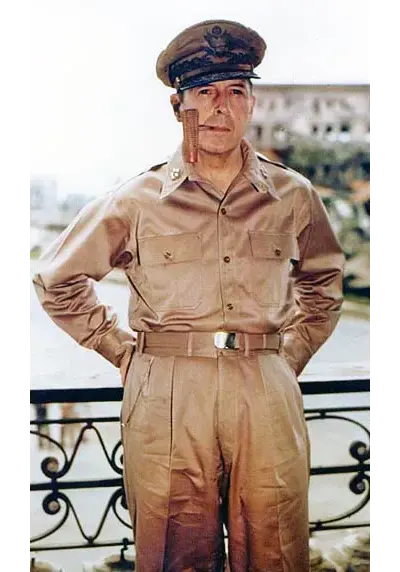
- Born: January 26, 1880
- Died: April 5, 1964
- Nationality: American
- Profession: Soldier
General of the Army Douglas MacArthur was an American five-star general and Field Marshal of the Philippine Army. He was Chief of Staff of the United States Army during the 1930s and played a prominent role in the Pacific theater during World War II. He received the Medal of Honor for his service in the Philippines campaign, which made him and his father Arthur MacArthur Jr. the first father and son to be awarded the medal. He was one of only five to rise to the rank of General of the Army in the U.S. Army, and the only one conferred the rank of field marshal in the Philippine Army.
