Douglas MacArthur Quotes
Neither did our men at first.
MacArthur was discussing his implementation of women’s suffrage in post World War II Japan. He was told by one of his staff that the Japanese men wouldn't like it: Ironically, the General was a great believer in civil rights for women (he had a very strong and powerful mother) yet he was an inveterate racist when it came to Blacks. See {605734} .
Douglas MacArthur, 1880-1964, General of the U. S. Army and Supreme Commander of the U. N. forces in Korea, Chief of Allied Occupation Forces in Japan, MacArthur
Sourced by: Eigen's Political and Historical Quotations

Perhaps there is no more dramatic quotation illustrating MacArthur’s arrogance where his own views and decisions should obviously prevail regardless of the policies of his superiors and his commander-in-chief. The army had been officially integrated by President Truman, The reality was that the general honestly believed that he had no superiors among the military, that civilians should not control the military, and in any event that the President—Truman—was not fit to be Commander-in-Chief.


His documentation of Bushido—the way of the warrior—has influenced Japanese culture and behavior even into modern times. This statement in large part explained the behavior of Japanese troops in WWII. Surrender was considered cowardice and therefore fighting to the death was required of all Japanese. This particular work was studied by American experts on Japan and the assumption that this was the Japanese cultural imperative for soldier and civilian alike, was one of the major factors leading Truman and America to use the Atomic bomb in WWII for they did not anticipate any Japanese surrender otherwise and an invasion of the Japanese mainland would have killed more Japanese and many Americans as well. Even after the first atomic bomb on Hiroshima, the Japanese would not surrender and it took the Emperor to finally contradict the Japanese culture as stated in Yamamoto Tsunetomo’s writing. See also {586232}.


At that point the Japanese were losing the war on every front. It is not clear whether Hirohito would actually have done such and not tried to escape in the end, however he certainly expected his subjects, military and civilian to do so. That expectation and the behavior of the Japanese troops fighting to the death on many islands was a powerful factor in leading Truman, Marshall and other key American leaders to use the Atomic Bomb. See Marshall: {641063}

It was this code, and its implementation in Saipan, Okinawa, and other Japanese held islands taken by the allies that caused Japanese soldiers to fight to the death or commit suicide. The prospect of this code being followed by Japanese soldiers, civilians or both in an invasion of the Japanese mainland, was one of the major arguments in favor of dropping the Atomic Bomb in World War II.
It was then customary to return with the head of a killed Samurai which would be made up as if in life so the dead man could be recognized. That way, the victor received more recognition with the importance of the Samurai who he defeated.


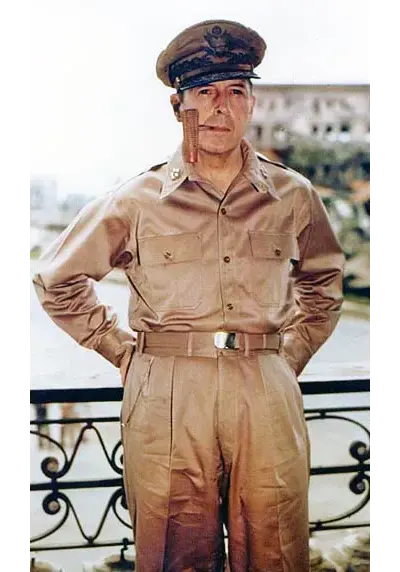
- Born: January 26, 1880
- Died: April 5, 1964
- Nationality: American
- Profession: Soldier
General of the Army Douglas MacArthur was an American five-star general and Field Marshal of the Philippine Army. He was Chief of Staff of the United States Army during the 1930s and played a prominent role in the Pacific theater during World War II. He received the Medal of Honor for his service in the Philippines campaign, which made him and his father Arthur MacArthur Jr. the first father and son to be awarded the medal. He was one of only five to rise to the rank of General of the Army in the U.S. Army, and the only one conferred the rank of field marshal in the Philippine Army.
