Winston Churchill Quotes
We shall not flag nor fail. We shall go on to the end. …. We shall fight on the beaches … we shall fight in the fields and in the streets … we shall never surrender.
Winston Churchill, 1874-1965, British Prime Minister (Conservative), Early World War II Address to the Nation when things looked bleak
Sourced by: Eigen's Political and Historical Quotations


At that point the Japanese were losing the war on every front. It is not clear whether Hirohito would actually have done such and not tried to escape in the end, however he certainly expected his subjects, military and civilian to do so. That expectation and the behavior of the Japanese troops fighting to the death on many islands was a powerful factor in leading Truman, Marshall and other key American leaders to use the Atomic Bomb. See Marshall: {641063}


He was a brutal, sadistic war criminal who was assassinated by one of his many enemies in 2000 before he could be brought to trial.

He always appeared in a military uniform after that.


This quotation is often used to illustrate the "Muslim propensity to violence". However, the context of the quotation was a historical circumstance whereby Muhammad's followers were endangered by others and the fighting was of a defensive nature. However, Islam is also a religion requiring believers to spread the religion. So, if there were people or countries or tribes that resisted conversion, the religion was interpreted by many Muslims as being under attack. Therefore violence was justified. In modern times, some religious leaders saw modernism and The West as a danger to Islam and it's tradition, therefore this and other passages of the Koran are often used to justify the terrorism that became so prevalent.
Soong's brothers-in-law were Dr. Sun Yat-sen and Generalissimo Chiang Kai-shek. He split with Chiang when he realized that Chiang was interested only of strengthening his power and fighting Mao and the Chinese Communists rather than the Japanese who occupied key parts of China. However, the Chinese had been fighting the Japanese for over 5 years and had while Japan occupied parts of Chine, they Japanese were still pinned down fighting the Chinese Communists, the American Volunteer Flying Tigers and occasional Chiang initiatives against the Japanese. Soong used the word democracy very liberally. China was divided between to power centers. Mao’s Communists and Chiang Kai-shek’s Nationalists. Both had “elections” but the Communists were a classic one party dictatorship of the left and Chiang was a classic dictator of the right. However, both were allies of the United States and enemies of Fascist Japan.

He became one of the great heroes of the American navy and this statement is taught to every American sailor. Actually, although a very good Captain, in the battle with the Shannon, he made a number of mistakes which was unusual for him, but the Shannon won the battle. The American sailors did not give up the ship, but they were overcome with one of the highest casualty rates of any sea battle of the time. Had Lawrence lived—he dies of infection from his wounds—he probably would have faced a board of inquiry or a court martial, but his death turned him into an American hero. See {625129}. Commodore Perry, a friend of Lawrence, had “Don’t Give Up The Ship” sewn on to his battle flag, and the motto has been part of the United States Navy ever since.

The South could not replenish their lost arms and munitions nor could they replace most of the men wounded, killed or taken prisoner. The Union could do both. Therefore as long as the Union army inflicted casualties, it mattered little who won which battle as long as the fighting was in the South. This critical strategic reality was never appreciated by the Union Generals who were generally reluctant to take large casualties. When Grant and Sherman finally were able to set the strategy of attrition in operation, the Union actually won most of the battles though he and Grant took very high casualties. The casualties of the Confederates were generally higher but they did not have to be for the Union to win. The Civil War was a strategic form of suicide. Ironically, at a few points the rebellion might have succeeded because of the incompetent and timid Union military leadership at the beginning of the war.

Adams is quoting from Cato, a play by Joseph Addison.


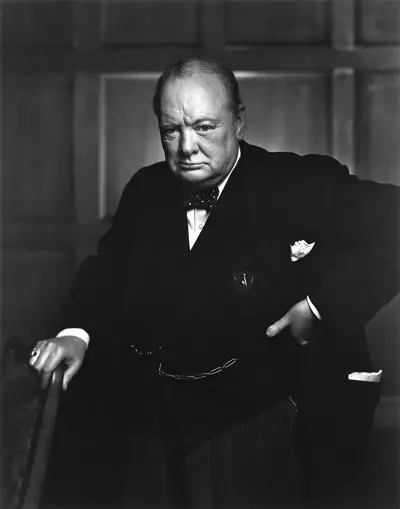
Sir Winston Leonard Spencer Churchill, KG, OM, CH, TD, DL, FRS, RA was the Prime Minister of the United Kingdom from 1940 to 1945, during the Second World War, and again from 1951 to 1955. Apart from two years between 1922 and 1924, Churchill was a Member of Parliament (MP) from 1900 to 1964 and represented a total of five constituencies. Ideologically an economic liberal and imperialist, he was for most of his career a member of the Conservative Party, as leader from 1940 to 1955. He was a member of the Liberal Party from 1904 to 1924. Churchill was also well known for his military career and as a historian, painter and writer, and among his many awards was the Nobel Prize in Literature.
