Clarence Darrow Quotes
Always the man on the ground has feared the new comer because he did not understand him. If a white man went into the Congo, he would be hated and misunderstood. That is your lot here. You have a long, long road to travel, an arduous foe to fight, and that foe is prejudice, which we have always had with us. It may be, that without slavery, your race would never have had its chance for civilization. You might still be savages in Africa---and you might be better off there. But still I think that civilization is worth the price we have to pay for it. You'll have to work harder---harder than the white man---because you're on his home grounds....There is no inherent difference between your capacity for growth and that of any other man, whatever his color.
He was lecturing to an audience of 1500 Blacks. Darrow was castigated for telling Negroes that they did not have an inherently inferior capacity from whites, This was feared would make them too demanding and insist on unrealistic equality.
Clarence Darrow, 1857-1937, Attorney and author, Lecture Delivered at the Detroit YMCA, November 8, 1925
Sourced by: Eigen's Political and Historical Quotations


Newsletter of the United Sons of Confederate Veterans

Perhaps there is no more dramatic quotation illustrating MacArthur’s arrogance where his own views and decisions should obviously prevail regardless of the policies of his superiors and his commander-in-chief. The army had been officially integrated by President Truman, The reality was that the general honestly believed that he had no superiors among the military, that civilians should not control the military, and in any event that the President—Truman—was not fit to be Commander-in-Chief.


This was actually a very courageous statement for an American politician running for national office. As a result of the pressure of this statement President Franklin Roosevelt allowed Black enlistment in the Army Air Forces.


Scott was then the Special Advisor on Negro Affairs to the Secretary of War in the Woodrrow Wilson administration. Wilaon hs commited U. S. Troops to fight oversease to "make the world safe for democracy", but many blacks and whites also saw gross hypocricy in asking Negores to fight for a Jim Crow, segregated America. See the related quotation 644805. Scott was also the major aide to Booker T, Washington, one of the leading Negro educators but a very pliable man on equal rights for the Blacks. The problem for the administration was much greater than that of WWII where the president was seen as very sympathetic to Blacks while Wilson was himself a racist. And in WWII the fight against the Nazis was a fight agaisnt racial supremacy. So this quotation and Scott's role was very important to the administration.

In the 1940’s equality and Civil Rights was a good wedge issue for Republicans because the most racist members of Congress were Democrats even though there were many Democrats who advocated strong civil rights. In 1964, there was a party realignment after the Congress passed the Civil Rights Act. After that the most racist members of Congress and the political established switched to the Republican Party and this caused the Republicans to publicly soft pedal civil rights issues. It now became a wedge issue for the democrats, and very few national Republican figures would make such a statement as it would be misinterpreted by the racial right wing of the party.

As enlightened and progressive that his views on Blacks were, he was amazingly racist when it came to Native Americans. See {588991}.


Captain W.W. Polk, commanding the Coast Guard revenue cutter Florida, wrote Treasury Secretary asking permission to employ a young Negro on board. Existing regulations prohibited such. The Negro in question was a free Black born in New York who was an “expert sailor for his age and competent to the duty of a boy of the first class.” Polk had hired the boy as a servant after he had worked at sea for another Captain. Good seamen were hard to come by, decision was extremely contentious. Ingham “compromised” by limiting the allowable role of Negroes at sea—a practice that lasted till the Second World War.


The editor at the time was Dr. William H. Boyle but no one is sure whether he, the owner, or someone else, wrote the editorial. The quotation illustrated a fascinating twist of logic that was very commonly held at the time. “If God created men of different colors, he must have meant them to be separate.” It is fascinating that virtually no one at the time made a similar argument about hair or eye color, intellect or other differential traits of people. Although this logical fallacy waned in the latter part of the 20th century, there are some who still hold to it.

Like many Black players of the era, Flood suffered endless hateful epithets and curses from a white crowd, many of whom resented the fact that Blacks were integrating baseball, but resented them even more when their performance exceeded that of a favorite white player.


Blacks were fighting and dying in WWII. They were equal when they were under fire, but otherwise not. The war was against fascist protagonists whose creed was inequality while the allies were upholding freedom and equality. But making that aspiration a reality was difficult.


This was an indirect slap at the Boy Scouts of America. At the time, racial segregation was legal and overtly practiced in the Southern States. The Boy Scouts could have been a great force for desegregation, but the leadership did not have that as a value for the organization. The Girl Scout leadership however saw the contradiction between segregation and the supposed values of America and their own organization. They were not only very active but very successful at desegregation at a time when they were atypical, and for most Americans, segregation was the norm.
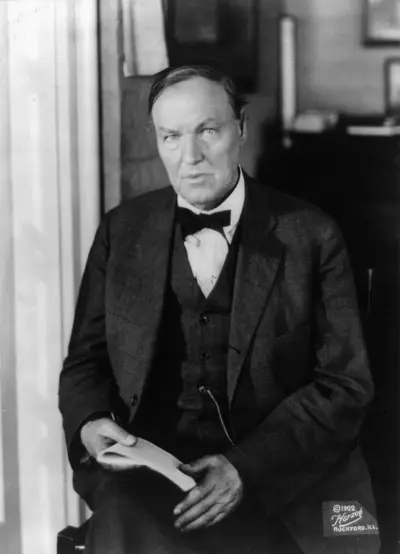
Clarence Seward Darrow was an American lawyer who became famous in the early 20th century for his involvement in the Leopold and Loeb murder trial and the Scopes "Monkey" Trial. He was a leading member of the American Civil Liberties Union, and a prominent advocate for Georgist economic reform.
