Paul Robeson Quotes
In Russia I felt for the first time like a full human being. No color prejudice like in Mississippi, no color prejudice like in Washington.
Paul Robeson, 1898-1976, Entertainer, Pacifist and Civil Rights Leader, Testimony before the House Committee on Un-American Activities June 12, 1956
Sourced by: Eigen's Political and Historical Quotations


This was actually a very courageous statement for an American politician running for national office. As a result of the pressure of this statement President Franklin Roosevelt allowed Black enlistment in the Army Air Forces.

The great contralto singer, Marian Anderson, an African American, had been refused by the Daughters of the American Revolution the use of Constitution Hall as a venue for her concert based on their White Performers Only policy. First Lady, Eleanor Roosevelt, resigned in protest from the DAR and she and the President asked Secretary Ickes to arrange a public concert at the Lincoln Memorial and he did. There was no Civil Rights Act at the time.

He was the only Black member of Congress at the time.

This was a very courageous speech for the President to give. Senator Hubert Humphrey had proposed civil rights legislation. At the time most of the racial conservative members of Congress were Democrats and not Republicans as they would become after Civil Rights legislation actually passed in 1964. There was little possibility that the civil rights law would pass as the Southern Democrats could filibuster it in the Senate. None the less Truman supported the legislation and the principle of equal rights despite the fact that he was a Southerner and he knew he would lose the support of the conservative wing of his party.

Having endured centuries of near slavery and discrimination, 70,000 Irish people signed this petition urging American-Irish immigrants to understand the similar plight of African-Americans and to join together with abolitionists. Irish immigrants were nevertheless reluctant to join the abolition movement because the movement was often tied to anti-Catholicism and many feared that the emancipation of Blacks would increase competition for the low-paying jobs immigrants held.

At the time, the Southern segregationists were all Democrats and they blocked any Democratic attempt to pass any Civil Rights legislation. When he could not get a Civil Rights commitment from his own party, Powell turned to the Republicans and the President wrote this letter. In return, in November, Powell endorsed and supported Eisenhower instead of Stevenson, his own party’s nominee. Eisenhower could not get any legislation on Civil Rights as the Southern Democrats would always block it. When President Lyndon Johnson finally forced the 1963 Civil Rights Act through the Congress, the racist Southern Democrats cut a deal with Goldwater and the conservative Republicans, and switched parties. Since then the Civil Rights stance of the two parties reversed. The Democrats were thereafter pro Civil Rights and the Republicans, the party of Lincoln and Reconstruction, thereafter reversed their Civil Rights position and opposed progress in this area.


Before the civil rights act was passed, most labor unions will racist and discriminated against black workers. The United Auto Workers union was an exception and Reuther was a strong advocate of desegregation and equal rights.


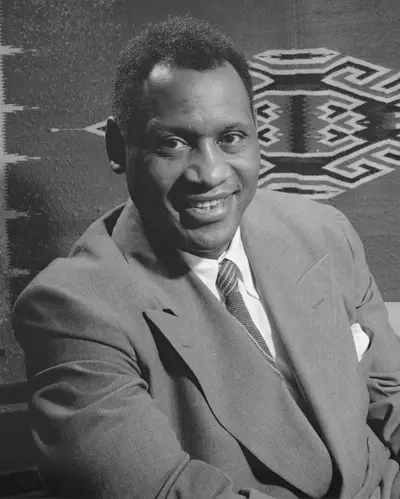
Paul Leroy Robeson was an American bass baritone concert artist and stage and film actor who became famous both for his cultural accomplishments and for his political activism. Educated at Rutgers College and Columbia University, he was a star athlete in his youth. He also studied Swahili and phonetics at the School of Oriental and African Studies in London in 1934. His political activities began with his involvement with unemployed workers and anti-imperialist students whom he met in Britain and continued with support for the Republican cause in the Spanish Civil War and his opposition to fascism. In the United States he became active in the Civil Rights Movement and other social justice campaigns. His sympathies for the Soviet Union and for communism, and his criticism of the United States government and its foreign policies, caused him to be blacklisted during the McCarthy era.
