Harry S. Truman Quotes
Our immediate task is to remove the last remnants of the barriers which stand between millions of our citizens and their birthright. There is no justifiable reason for discrimination because of ancestry or religion or race or color.
This was a very courageous speech for the President to give. Senator Hubert Humphrey had proposed civil rights legislation. At the time most of the racial conservative members of Congress were Democrats and not Republicans as they would become after Civil Rights legislation actually passed in 1964. There was little possibility that the civil rights law would pass as the Southern Democrats could filibuster it in the Senate. None the less Truman supported the legislation and the principle of equal rights despite the fact that he was a Southerner and he knew he would lose the support of the conservative wing of his party.
Harry S Truman, 1884-1972, 33rd President of the United States (Democrat, MO), Speech 1947
Sourced by: Eigen's Political and Historical Quotations

This was actually a very courageous statement for an American politician running for national office. As a result of the pressure of this statement President Franklin Roosevelt allowed Black enlistment in the Army Air Forces.

At the time, the Southern segregationists were all Democrats and they blocked any Democratic attempt to pass any Civil Rights legislation. When he could not get a Civil Rights commitment from his own party, Powell turned to the Republicans and the President wrote this letter. In return, in November, Powell endorsed and supported Eisenhower instead of Stevenson, his own party’s nominee. Eisenhower could not get any legislation on Civil Rights as the Southern Democrats would always block it. When President Lyndon Johnson finally forced the 1963 Civil Rights Act through the Congress, the racist Southern Democrats cut a deal with Goldwater and the conservative Republicans, and switched parties. Since then the Civil Rights stance of the two parties reversed. The Democrats were thereafter pro Civil Rights and the Republicans, the party of Lincoln and Reconstruction, thereafter reversed their Civil Rights position and opposed progress in this area.


In the 1940’s equality and Civil Rights was a good wedge issue for Republicans because the most racist members of Congress were Democrats even though there were many Democrats who advocated strong civil rights. In 1964, there was a party realignment after the Congress passed the Civil Rights Act. After that the most racist members of Congress and the political established switched to the Republican Party and this caused the Republicans to publicly soft pedal civil rights issues. It now became a wedge issue for the democrats, and very few national Republican figures would make such a statement as it would be misinterpreted by the racial right wing of the party.


He was the first FHA administrator to make statements saying that non-discriminatory housing services should be available to the American people. He was not able to change the agency’s equal opportunity performance because the Southern states had laws allowing and protecting legal segregation especially in housing. The Southern staff interpreted his position to be sure that both blacks and whites had access to FHA services, but they used the “separate but equal” doctrine: Provide services to both races but always in segregated housing projects. This was typical of the kinds of problems that motivated the Civil Rights Acts offered by President Kennedy in 1963 and passed by President Johnson in 1964 See {637271} for a similar Mason statement.

In the 1930s African Americans who traveled were subject to countless humiliations whenever the sought hotels, rooming houses, restaurants and other accommodations. Gas stations would not allow them to use bathrooms and they were reduced to using open fields. Traveling and vacationing was, for Blacks, humiliating. Wikipedia: “Green reviewed hotels and restaurants that did business with African Americans during the time of Jim Crow laws and racial segregation in the United States. He printed 15,000 copies each year. In the 1930s, Green began his work by compiling data on stores in the New York area that accepted black travelers, and published his first guide in 1936. Similar guides had been published for Jewish travelers, who sometimes faced discrimination. Green's guide was so popular that he immediately began to expand its coverage the next year to other US destinations, adding hotel and restaurants as well.”


Having endured centuries of near slavery and discrimination, 70,000 Irish people signed this petition urging American-Irish immigrants to understand the similar plight of African-Americans and to join together with abolitionists. Irish immigrants were nevertheless reluctant to join the abolition movement because the movement was often tied to anti-Catholicism and many feared that the emancipation of Blacks would increase competition for the low-paying jobs immigrants held.

This was the first major civil rights speech. He had previously in his political career tread carefully in the civil rights arena. The Southerners had disproportionate control over the Congressional committee chairmanships and they could hold up his entire legislative agenda. JFK’s father was a right wing fascist who supported Hitler earlier and always advised against pushing civil rights.


Lieber was assigned by President Lincoln to study the then international laws of war and prepare a manual for the guidance of union troops in the Civil War. Lincoln then issued the document as a general order. This statement was critical in inhibiting the South from making good on their threat to enslave any Black Union Soldier Captured and to execute any Union Black soldier who was a runaway slave from the South. Lincoln threatened to retaliate and also to hold senior Confederate officers accountable for following these rules. General Sherman and other Union Senior Officers executed a few Confederate soldiers who violated rules of the order and the “illegal” practices stopped, and with few exceptions the senior officers of both sides followed Lieber’s rules. These rules, with few modifications, governed U. S. military policies and rules through the Second World War.

Before the civil rights act was passed, most labor unions will racist and discriminated against black workers. The United Auto Workers union was an exception and Reuther was a strong advocate of desegregation and equal rights.

This was an indirect slap at the Boy Scouts of America. At the time, racial segregation was legal and overtly practiced in the Southern States. The Boy Scouts could have been a great force for desegregation, but the leadership did not have that as a value for the organization. The Girl Scout leadership however saw the contradiction between segregation and the supposed values of America and their own organization. They were not only very active but very successful at desegregation at a time when they were atypical, and for most Americans, segregation was the norm.


The case was Shelley v. Kraemer where the Supreme Court outlawed discriminatory restrictive covenants A restrictive covenant was a condition that was written into the deed on a piece of property. Even if the owner of the home did not want to discriminate, the previous owners who wrote the restrictive covenant into the deed (or his relatives and heirs) could sue and invalidate the sale. In many cases, insurance would not sell title insurance or banks would not give mortgages for a Black or a Jew where there was a covenant in the deed, even if the covenant was more than 100 years old. Homeowner associations would also enforce the covenants which were originally written into all the deeds of the development. Once the supreme court ruled that restrictive covenants were unconstitutional, no court would enforce any of these lawsuits. It was one of the fastest steps forward in the history of Civil Rights since the day after the court decision racists could no longer enforce the covenants that were in tens of millions of deeds in America.

The great contralto singer, Marian Anderson, an African American, had been refused by the Daughters of the American Revolution the use of Constitution Hall as a venue for her concert based on their White Performers Only policy. First Lady, Eleanor Roosevelt, resigned in protest from the DAR and she and the President asked Secretary Ickes to arrange a public concert at the Lincoln Memorial and he did. There was no Civil Rights Act at the time.


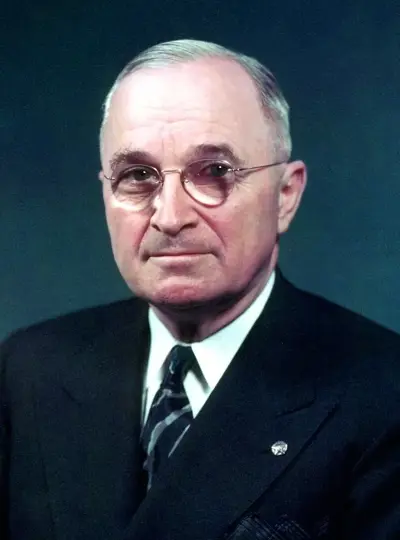
Harry S. Truman was an American politician who served as the 33rd President of the United States (1945–53). He served as a United States Senator from Missouri (1935–45) and briefly as Vice President (1945) before he succeeded to the presidency on April 12, 1945 upon the death of Franklin D. Roosevelt. He was president during the final months of World War II, and approved the plan to drop atomic bombs on Hiroshima and Nagasaki. Truman was elected in his own right in 1948. He presided over an uncertain domestic scene as America sought its path after the war and tensions with the Soviet Union increased, marking the start of the Cold War.
