Gregory XVI Quotes
We warn and adjure earnestly in the Lord faithful Christians of every condition that no one in the future dare to vex anyone, despoil him of his possessions, reduce to servitude, or lend aid and favour to those who give themselves up to these practices, or exercise that inhuman traffic by which the Blacks, as if they were not men but rather animals, having been brought into servitude, in no matter what way, are, without any distinction, in contempt of the rights of justice and humanity, bought, sold, and devoted sometimes to the hardest labour. Further, in the hope of gain, propositions of purchase being made to the first owners of the Blacks, dissensions and almost perpetual conflicts are aroused in these regions. We prohibit and strictly forbid any Ecclesiastic or lay person from presuming to defend as permissible this traffic in Blacks under no matter what pretext or excuse, or from publishing or teaching in any manner whatsoever, in public or privately, opinions contrary to what We have set forth in this Apostolic Letter.
While this apostolic letter condemned the slave trade, it fell short of clearly implicating the entire practice of slavery. It is clear that the Catholic Church at this time was reluctant to abandon its earlier teaching which approved of “just title” slavery. This distinction approved of “slavery” in circumstances in which the person was deprived of their liberty justly. Specific examples in the past have included slaves captured in war, persons condemned to slavery for a crime, and those who sold themselves into slavery.
Gregory XVI, 1765-1846, Roman Catholic Pope, In Supremo Apostolatus Fastigio (Condemnation of the Slave Trade), 1839
Sourced by: Eigen's Political and Historical Quotations

Though Leo XIII was very much opposed to slavery, his claim that the Catholic Church “from the beginning” sought to end slavery overlooks the inconsistent reality of several of his predecessors’ teachings. For an example of this inconsistency one may find a relevant example as late as the 19th century, see the teachings of Gregory XVI {611428}, Pius IX {612304}, and Leo XIII {611844}

The defense of slavery in this Instruction is not a defense of the racial slavery that was prevalent in the South prior to the Civil War, but rather a philosophical defense of a just conception of slavery. Even so the Pope’s justification of the buying and selling of slaves flew in the face of a papal document issued by Gregory XVI twenty-seven years earlier {611428}. “Just titles” of slavery were approved by the Catholic Church in circumstances in which the person was deprived of their liberty justly. Specific examples in the past included slaves captured in war, persons condemned to slavery for a crime, and those who sold themselves into slavery. Even though the Vatican was defending “just titles” of slavery, this teaching has been seen as regressive and highly contradictory to true Catholicism. After this Instruction the distinction between just and unjust slavery in Catholic teaching would erode and twenty-one years later Pope Leo XIII {611844} would condemn slavery and openly support abolition throughout the world.


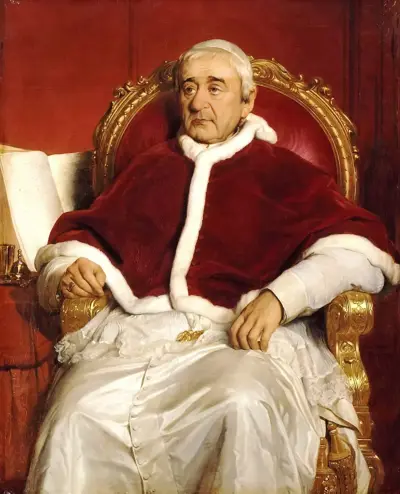
Pope Gregory XVI was head of the Catholic Church and ruler of the Papal States from 2 February 1831 to his death in 1846. He had adopted the name Mauro upon entering the religious order of the Camaldolese.
