BENJAMIN RUSH


Second to Benjamin Franklin, Rush was the only other real scientist of the American colonial era.
General Howe was the Commander of British Troops in the American Revolution. The early American Army was neither professional, experienced, or well officered. Execution as a means of punishment was much more common than in the larger, professional British army. Rush ran the hospitals for the Revolutionary Army and talked to many officers and enlisted men, and also observed much of the British military practices.
Worry about the disproportional power of the rich is not a modern concern, but was a concern from the very beginning of the nation. There was a belief that if there were a legislative body representing the entire population the rich would tend to dominate it. The solution that England had found was a bicameral Parliament—a House of Lords representing the wealthy and the powerful and the House of Commons, representing the bulk of the people. America followed suit but never did have the class distinction of England.
We are so accustomed to thinking about George Washington as a great military leader that it is surprising to see contemporary comparisons where Washington was found wanting or second. Actually Horatio Gates was a brilliant tactical general and a great leader of men—many think far better than Washington, but the genius of Washington was his strategic and political grasp of the situation. Essentially, with exceptions like the Battle of Trenton, Washington lost almost all the battles he fought as a tactical general. He realized early on that he did not have to win battles; he just had to prevent losing them so badly that he could not continue the fight. The insurgent wins as long as he can still fight. The British could not win unless they eliminated the ability of the revolutionists to fight. But Washington won the last battle at Yorktown, and that is the one that counted. Rush ran the hospitals for the Revolutionary Army and talked to many officers and enlisted men, and also observed much of the British military practices.
Despite his warning---and that of others—all that they could get agreement upon had each of these three weaknesses. After winning the American Revolution, the new country found the Articles of Confederation and the Continental Congress completely inadequate and finally in 1787 there was a Constitutional Convention held in secret in Philadelphia to overcome the weaknesses of the existing structure of which the warnings of Rush were three of the problems that had to be fixed.
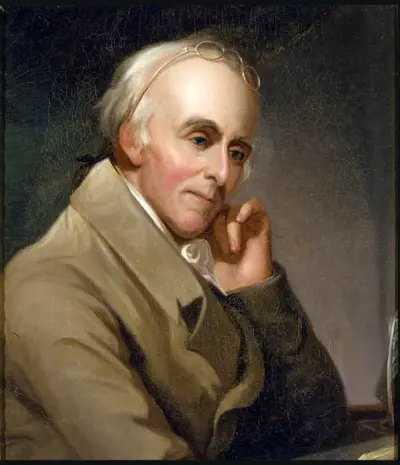
Benjamin Rush was a signer of the United States Declaration of Independence and a civic leader in Philadelphia, where he was a physician, politician, social reformer, humanitarian, and educator and the founder of Dickinson College. Rush attended the Continental Congress. His later self-description there was: "He aimed right." He served as Surgeon General of the Continental Army and became a professor of chemistry, medical theory, and clinical practice at the University of Pennsylvania.
