Benjamin Rush Quotes
… we are on the brink of ruin. I am distressed to see the minions of a tyrant more devoted to his will than we are to a cause in which the whole world is interested. New measures and new men alone can save us. The American mind cannot long support the present complexion of affairs. Let our army be reformed. Let our general officers be chosen annually. The breaking of 40 regiments, and the dismissal of one field officer from every regiment & of one subaltern from every company will save many millions to the continent. Your army by these means may be made respectable & useful. But you must not expect to fill it with soldiers for 3 years, or during the war. The genius of America rebels against the scheme. Good General Officers would make an army of six months men an army of heroes.
the soldiers of King George The early American Revolutionary Army was not led by many competent seniors officers. Many of the general officers were such by virtue of socio-economic class rather than talent or merit. Rush ran the hospitals for the Revolutionary and talked to many officers and enlisted men, and also observed much of the British military practices.
Benjamin Rush, 1745-1813, Physician & member of the Continental Congress, Surgeon General of the Continental Army and Treasurer of the U.S. Mint, Letter to John Adams, 1777
Sourced by: Eigen's Political and Historical Quotations

The crackdown on Boston which was intended to set an example and intimidate all of the other colonies backfired, and the British were told about it by their own officials in America. But they were so rigid and ideological about monarchy, that the stimulated rebellion rather than suppress them.

Amazingly, a critical mass of Middle Atlantic citizens, joined in a vision of independence and persuaded their colonies to make common cause with the other colonies to gain independence from England and an end to monarchy. In a way, they had the most to lose and the least to gain from the revolution. Led by Livingston, John Jay, Alexander Hamilton, and Benjamin Franklin and others, these states had the greatest intellectual commitment to the Revolution as they would not financially benefit and would likely lose economically.


Conway was made a Major General by Congress and appointed as Inspector General of the Revolutionary Army. However, then as now, officers who told the truth about the failings of other senior officers were not well liked by the officer corps. The cover up was the norm even then. Rush ran the hospitals for the Revolutionary Army and talked to many officers and enlisted men, and also observed much of the British military practices.
General Howe was the Commander of British Troops in the American Revolution. The early American Army was neither professional, experienced, or well officered. Execution as a means of punishment was much more common than in the larger, professional British army. Rush ran the hospitals for the Revolutionary Army and talked to many officers and enlisted men, and also observed much of the British military practices.
We are so accustomed to thinking about George Washington as a great military leader that it is surprising to see contemporary comparisons where Washington was found wanting or second. Actually Horatio Gates was a brilliant tactical general and a great leader of men—many think far better than Washington, but the genius of Washington was his strategic and political grasp of the situation. Essentially, with exceptions like the Battle of Trenton, Washington lost almost all the battles he fought as a tactical general. He realized early on that he did not have to win battles; he just had to prevent losing them so badly that he could not continue the fight. The insurgent wins as long as he can still fight. The British could not win unless they eliminated the ability of the revolutionists to fight. But Washington won the last battle at Yorktown, and that is the one that counted. Rush ran the hospitals for the Revolutionary Army and talked to many officers and enlisted men, and also observed much of the British military practices.
Rush ran the hospitals for the Revolutionary Army and talked to many officers and enlisted men, and also observed much of the British military practices. These suggestions were discussed but never passed as regulations. They are fascinating insights into the problems of the general officers of the time who were generally selected for their socioeconomic status rather than other qualifications. Note the drunkenness limitation for a commanding general was proposed to be limited to only 1 allowed bout of drunkenness every 24 hours. It was, he thought, totally unrealistic to require generals to be always sober when on duty. With the mediocre quality of senior officers, Washington had to depend on foreigners like Lafayette, Von Steuben and others. And Generals who were leading attacks out in front of their men like Benedict Arnold immediately became heroes and one of the reasons he ended up as a traitor was that he thought that he was badly treated relative to the “society” Generals who would not accept him and denigrated his exploits when they themselves had never been close to a battle front.

1st Earl of Chatham. The speech was given in the midst of the American Revolution.

He was acting as French Foreign Secretary at the time.

1776 at the Battle of Bunker Hill This was the first formal battle of the American Revolution. The British officers perceived the American colonials as a rag-tag collection of men with no experience or skill at arms. Looking for glory they led from the front and if nothing else the Colonials were superb marksmen who picked the officers off easily. After that battle, British officers were more prudent and respectful of the revolutionaries.

Of the 13 colonies, the 3 Middle Atlantic States, were the least enthusiastic about an armed revolution against England. Jersey—Now New Jersey—was the most recalcitrant then with Benjamin Franklin’s son as Governor. See {634108} for an explanation of why that was.

Several years before the Battle of Bunker Hill, revolutionary activity had already broken out in the American colonies—See {634132} for an example. This law gave the British authorities much more “clout” in dealing with the “seditious” American activities. It protected English law enforcement officials from being tried in local Colonial courts for murder or assault in putting down insurrections. George Washington and other Patriots were outraged over this law. See {634131}.

Howe had written Franklin attempting to stave off a American break with England. Franklin, with the approval of the Continental Congress, replied.

During the American Revolution, conditions were very difficult for Washington’s soldiers who were ill armed, ill clothed, and ill fed while they were paid irregularly. At one point morale was so low that some of the soldiers revolted. Smyth observes that Washington and Congress disciplined the mutineers very mildly, especially when compared with the way the British would deal with such things. The British Governor Clinton tried to take advantage of the mutiny and the poor morale by announcing that all of Washington’s troops who wished could obtain amnesty and join the British forces where the pay and conditions were much better. Professor Smyth found it fascinating that none of the Americans would join the British and he credits it to the wise and mild discipline policies of Washington and Congress as well as the general perception of the justice of the American cause among the American troops.

Mechanics was a general term for people who made things, or fixed things. Ramsay was the first major historian of the American Revolution.
Earlier, his father had also castigated the ministers over their inept hard-line handling of the American Revolution. See {641505} .
At that time, Russia and Germany were autocracy, and the ruler could simply take the English money and force the soldiers to fight in a war they had not stake in nor understood.

2nd Earl of Guilford. This bill cut off all trade with the American Colonies. It was meant as pressure to cease the rebellion. It did not work.
during and after the American Revolution

This quotation shows that the dissent leading to the American Revolution did not emerge suddenly in 1776 after the Battle of Bunker Hill. Dissent, sedition and even violence was documented here in 1774. Salem at the time was the second largest port in the colony and the customs tax collectors—Loyalist Americans—were run out of Salem.

Most Canadians supported the English despite the letter.

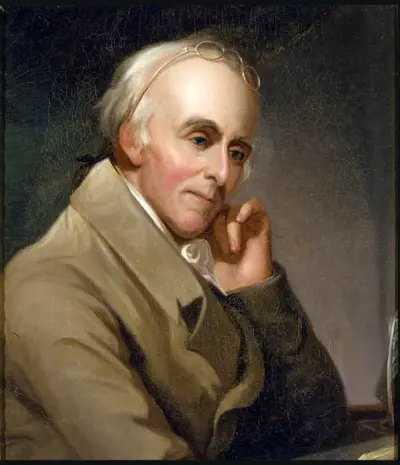
Benjamin Rush was a signer of the United States Declaration of Independence and a civic leader in Philadelphia, where he was a physician, politician, social reformer, humanitarian, and educator and the founder of Dickinson College. Rush attended the Continental Congress. His later self-description there was: "He aimed right." He served as Surgeon General of the Continental Army and became a professor of chemistry, medical theory, and clinical practice at the University of Pennsylvania.
