Benjamin Rush Quotes
An officer in Howe's army told me they executed ONLY two men in the last year. Their discipline prevents crimes. OUR WANT of it creates them. We have had 20 executions in the last year, & our army is not a bit the better for them. If Howe should lie still, desertions, sickness, accidental deaths & executions would waste our whole army in one year.
General Howe was the Commander of British Troops in the American Revolution. The early American Army was neither professional, experienced, or well officered. Execution as a means of punishment was much more common than in the larger, professional British army. Rush ran the hospitals for the Revolutionary Army and talked to many officers and enlisted men, and also observed much of the British military practices.
Benjamin Rush, 1745-1813, Physician & member of the Continental Congress, Surgeon General of the Continental Army and Treasurer of the U.S. Mint, Letter to John Adams, October 1, 1777
Sourced by: Eigen's Political and Historical Quotations


Rush ran the hospitals for the Revolutionary Army and talked to many officers and enlisted men, and also observed much of the British military practices. These suggestions were discussed but never passed as regulations. They are fascinating insights into the problems of the general officers of the time who were generally selected for their socioeconomic status rather than other qualifications. Note the drunkenness limitation for a commanding general was proposed to be limited to only 1 allowed bout of drunkenness every 24 hours. It was, he thought, totally unrealistic to require generals to be always sober when on duty. With the mediocre quality of senior officers, Washington had to depend on foreigners like Lafayette, Von Steuben and others. And Generals who were leading attacks out in front of their men like Benedict Arnold immediately became heroes and one of the reasons he ended up as a traitor was that he thought that he was badly treated relative to the “society” Generals who would not accept him and denigrated his exploits when they themselves had never been close to a battle front.

While most modern armies treat officers and enlisted men who desert equally or even favor the officers, the Visigoths made desertion by an officer the severest of crimes. A centurion was the officer in charge of 100 men. There were 10 decurians (leaders of 10) under him, They were the modern equivalent of the Sergeants—non-commissioned officers. Their penalty for desertion was only the paying of a heavy fine. It was the officers who had to set the example. This set of laws is the most formalized and sophisticated compendium of laws of the so-called “barbaric peoples” of Europe. The compilation was in many ways a documentation of the traditional laws of the Visigoths that had evolved over hundreds of years.


Washington, though a military officer at the time, was very concerned with protecting the rights of citizens from abuse by the military for he had seen much of the abuse. The third amendment for example was later written to protect people from the military. The Constitution also requires that Congress make such rules for the military. Note that Washington, our first senior military officer at the time, wanted Congress to make detailed rules for the conduct of soldiers. In the 20th and 21st century, as the imperial presidency developed, there was a political view that only the military officers and the Commander in Chief should make the rules and regulations for the soldiers. However, there was no question but that the Founding Fathers saw this as a legislative branch function. Congress and Presidents have contested for this power every since.


History is replete with instances of military coups. In the final analysis, in every country at all times, there is no force in a society that could cope with a military which decides to act on its own. The Founding Fathers were very conscious of this reality and history, hence the firm civilian control of the military in America.
The issue of how to raise an army plagued the Founding Fathers. The State Militias had very short enlistment periods so that as soon as the soldiers had been trained and were effective, their enlistments would be up. Washington and others wanted a draft or at least long enlistment periods in an American Army. The debate which then began has never ended. How much regular Army as opposed to the Army Reserves—the equivalent of the State Militias, whether or not there should be a draft, whether or not an enlistment period may be extended if there is a military need—none of these are new issues but have been with us since the country was founded. See {591369} for more of Washington’s view of this issue.

We are so accustomed to thinking about George Washington as a great military leader that it is surprising to see contemporary comparisons where Washington was found wanting or second. Actually Horatio Gates was a brilliant tactical general and a great leader of men—many think far better than Washington, but the genius of Washington was his strategic and political grasp of the situation. Essentially, with exceptions like the Battle of Trenton, Washington lost almost all the battles he fought as a tactical general. He realized early on that he did not have to win battles; he just had to prevent losing them so badly that he could not continue the fight. The insurgent wins as long as he can still fight. The British could not win unless they eliminated the ability of the revolutionists to fight. But Washington won the last battle at Yorktown, and that is the one that counted. Rush ran the hospitals for the Revolutionary Army and talked to many officers and enlisted men, and also observed much of the British military practices.
the soldiers of King George The early American Revolutionary Army was not led by many competent seniors officers. Many of the general officers were such by virtue of socio-economic class rather than talent or merit. Rush ran the hospitals for the Revolutionary and talked to many officers and enlisted men, and also observed much of the British military practices.
This is an aspect of the American Revolution that is rarely described in American history books. Rush ran the hospitals for the Revolutionary Army and talked to many officers and enlisted men, and also observed much of the British military practices.
1776 at the Battle of Bunker Hill This was the first formal battle of the American Revolution. The British officers perceived the American colonials as a rag-tag collection of men with no experience or skill at arms. Looking for glory they led from the front and if nothing else the Colonials were superb marksmen who picked the officers off easily. After that battle, British officers were more prudent and respectful of the revolutionaries.

During the American Revolution, conditions were very difficult for Washington’s soldiers who were ill armed, ill clothed, and ill fed while they were paid irregularly. At one point morale was so low that some of the soldiers revolted. Smyth observes that Washington and Congress disciplined the mutineers very mildly, especially when compared with the way the British would deal with such things. The British Governor Clinton tried to take advantage of the mutiny and the poor morale by announcing that all of Washington’s troops who wished could obtain amnesty and join the British forces where the pay and conditions were much better. Professor Smyth found it fascinating that none of the Americans would join the British and he credits it to the wise and mild discipline policies of Washington and Congress as well as the general perception of the justice of the American cause among the American troops.

This militia shall be ready to march with only In the popular vernacular, they were called “Minute Men”. Within a few weeks, similar reorganizations took place in Essex, Suffolk, and Middlesex Counties. In early October, the First Massachusetts Provincial Congress, meeting in Concord, adopted the Minute Man concept for the entire state.
loyalty oath to the King of England His “Ethiopian Regiment” was the first Black military regiment in North America. Soon after, Rhode Island organized a Black military unit—see {613949}.
Washington took advantage of the new technology of explosives that had been developed and created an innovative new unit under the command of David Bushnell (1740–1824) the Yale University student who had invented the first time bomb and the Turtle submarine.

Cornwallis, who had the misfortune to be the Commanding General of the British forces which were defeated by the brilliant strategy of George Washington and his French Allies, never approved of the British Strategy in America. As a loyal officer, he was a field commander and did not control the overall strategy which most military historians agree was not very sound. While the British controlled New York City, they were surrounded by Washington’s troops and a hostile population. They Armies were separated and while generally too strong to defeat in the field were never strong enough or numerous enough to pacify large areas of the colonies.

Mechanics was a general term for people who made things, or fixed things. Ramsay was the first major historian of the American Revolution.


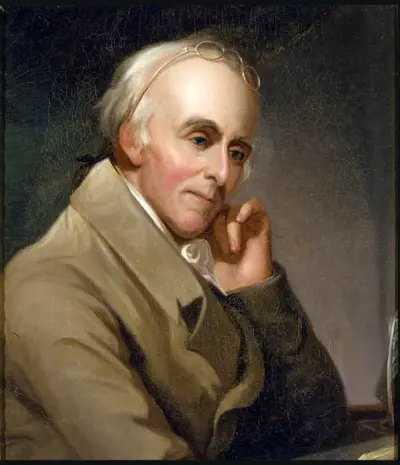
Benjamin Rush was a signer of the United States Declaration of Independence and a civic leader in Philadelphia, where he was a physician, politician, social reformer, humanitarian, and educator and the founder of Dickinson College. Rush attended the Continental Congress. His later self-description there was: "He aimed right." He served as Surgeon General of the Continental Army and became a professor of chemistry, medical theory, and clinical practice at the University of Pennsylvania.
