Benjamin Franklin Quotes
It is impossible we should think of submission to a government that has with the most wanton barbarity and cruelty our defenseless towns … excited the savages to massacre our peaceful farmers, and our slaves to murder their masters, and is even now bringing foreign mercenaries to deluge our settlements in blood.
Howe had written Franklin attempting to stave off a American break with England. Franklin, with the approval of the Continental Congress, replied.
Benjamin Franklin, 1706-1790, Governor of Pennsylvania, Member of the Continental Congress & the Constitutional Convention, Governor of Pennsylvania, President of the Pennsylvania Assembly, U.S. Minister to France, Postmaster General of the American Colonies, Letter to British Commander, Lord Howe, 1776
Sourced by: Eigen's Political and Historical Quotations

The Greeks committed many atrocities in their war with Turkey. See {584483}


A Cossack revolt had broken out in 1707 and was put down by the Czar’s forces. He then issued what might be one of the first official orders for genocide. Few Cossacks survived.

There is disagreement amongst historians as to whether or not the atrocities attributed to the retreating British troops were actually true. There are two other possibilities. First, this report was made only a week after the battle itself and less than that since the alleged atrocities would take place as the British retreated. There were certainly all kinds of rumors with information passed from person to person with no modern means of documentation. The Provisional Congress may have sincerely thought that all the events occurred but they may have been the result of inadvertent exaggeration. Then there is the possibility that in order to fire up the Americans to join the war, some or all of the atrocity reports were deliberately fabricated. It would only take two or three delegates to agree on such a strategy and they could “confirm” each other’s accounts of the happenings. Of course it might all be true. However, as the British retreated to Boston where they had reinforcements, they did not have a lot of time for malicious atrocities. All along the route, Minutemen, local farmers and townspeople continued the attack against the British. By the time the British soldiers reached Boston, 73 British solders were dead and 174 more were wounded. In war truth does not have the respect that it usually does. See {626632}.

Yuliy Osipovich Martov. Criticism of the Bolshevik behavior in dealing with counter-revolutionaries in the civil war that followed the Russian Revolution. This despite the fact that the death penalty had been abolished right after the Revolution. See {590510}
First Published American Indian Author. His last public speech. He was referring to a horrible massacre of Christian Indians and the polarizing effect that such conflicts had. Whosoever publicly castigated a massacre of whites or Indians would be met by accusations of condoning the massacres of the other side and ignoring the inevitable and natural seeking of retaliation for future protection and revenge.

To this day there is a large stature of Montecino prominent in the skyline of Santo Domingo.
Referring to the behavior of English King Edward I, 1239-1307, towards Scotland:

Roger’s Rangers of the French & Indian War were the first using unconventional warfare and invented the “deep raid” when they went in stealth all the way to Quebec and defeated the Abnaki Indians in their home village rather than defend against the Indians’ French coordinated attacks on upper York State. Rogers was portrayed by Spencer Tracy in the film Northwest Passage depicting the raid. All the men were killed but the women and children were captured and released with the exception of 5 teenagers who the Rangers took with them. This was one of the first formal “Rules of War” in what was otherwise a viciously uncivilized war.

Tens of thousands of Iranians were.

At that time, Russia and Germany were autocracy, and the ruler could simply take the English money and force the soldiers to fight in a war they had not stake in nor understood.

Lawrence of Arabia. In the Middle East, Lawrence led a small Arab army against the Turks and the Germans. In a battle near Tafas, the captured 250 Turkish and German soldiers as prisoners. They them shot them all in cold blood with their Hotchkiss machine gun. What makes this quotation so significant is that one of the great British heroes of WWI was actually guilty of War Crimes. An American journalist gave Lawrence and his exploits great publicity without mentioning the atrocities. The British chain of command also ignored the transgression of one of the most fundamental rules of war even though the clear evidence was in basic battle report files. However, the British never removed the report from the files or destroyed it. The Turks and the Germans while they respected the rules of war with the English, French, and most allies, treated the Arabs much more harshly and murdered Arab prisoners on many occasions. In part this atrocity at Tafas was an act of vengeance and retaliation. But Lawrence never even tried to explain it.

Earlier, his father had also castigated the ministers over their inept hard-line handling of the American Revolution. See {641505} .


Two months earlier, Jinnah and the Muslim League had, behind the scenes, orchestrated and abetted vicious, murderous, terrorist attacks on Sikhs by Muslim tribesman brought into the Punjab for the purpose." Master Tara Singh


Eldest son of Robert Walpole. Lord Dunmore, royal governor of Virginia, had issued a proclamation offering freedom to slaves willing to defend the Crown

Roosevelt had little respect for Miles who was an enemy of the President’s. Incredibly enough, Roosevelt wrote this sentence in a letter to the general. However, the President’s aids persuaded him not to send the letter not only because it was so confrontational with Miles but it was a Presidential admission that there had been a “massacre” for which the United States military was responsible. For a parallel situation in World War II England, see Winston Churchill {597711}. Roosevelt remembered the incident and later when Miles stepped out of line, Roosevelt ended the general’s career—see {589012}. This quotation when considered against the {588991} quotation demonstrates the very complex nature of TR’s character and views. He did not like Indians and had disparaged them and commented that dead Indians were good Indians. Yet he had a very strong sense of honor and was greatly offended by the massacre of unarmed Indians and women and children.
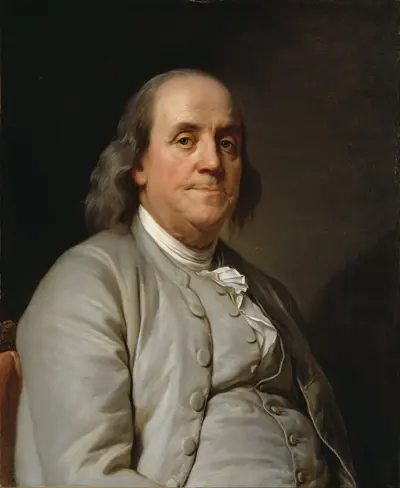
Benjamin Franklin FRS FRSA FRSE was one of the Founding Fathers of the United States. A polymath, he was a leading writer, printer, political philosopher, politician, Freemason, postmaster, scientist, inventor, humorist, civic activist, statesman, and diplomat. As a scientist, he was a major figure in the American Enlightenment and the history of physics for his discoveries and theories regarding electricity. As an inventor, he is known for the lightning rod, bifocals, and the Franklin stove, among other inventions. He founded many civic organizations, including the Library Company, Philadelphia's first fire department, and the University of Pennsylvania.
