Theodore Roosevelt Quotes
In the Wounded Knee fight, the troops under your command killed squaws and children as well as unarmed Indians.
Roosevelt had little respect for Miles who was an enemy of the President’s. Incredibly enough, Roosevelt wrote this sentence in a letter to the general. However, the President’s aids persuaded him not to send the letter not only because it was so confrontational with Miles but it was a Presidential admission that there had been a “massacre” for which the United States military was responsible. For a parallel situation in World War II England, see Winston Churchill {597711}. Roosevelt remembered the incident and later when Miles stepped out of line, Roosevelt ended the general’s career—see {589012}. This quotation when considered against the {588991} quotation demonstrates the very complex nature of TR’s character and views. He did not like Indians and had disparaged them and commented that dead Indians were good Indians. Yet he had a very strong sense of honor and was greatly offended by the massacre of unarmed Indians and women and children.
Theodore Roosevelt, 1858-1919, 26th President of the United States (Republican, NY), Letter to Nelson A. Miles, 1835-1925, General and Commander in Chief of the U. S. Army, 1902
Sourced by: Eigen's Political and Historical Quotations

To many, this quotation is shocking. TR was a presidential pioneer in race relations being the first President to ever invite a Black to dine at the White House. See {588996} for his views on Blacks. Although modern and liberal with respect to most minorities, TR had a major blind spot regarding Native Americans and was among the worst racists.
Miles, a hero of the Indian Campaigns (although he led the atrocities at the massacre at Wounded Knee) and then the leading military figure in America was an opponent of the policies of the new young President and had political aspirations of his own for the Presidency. Miles’ opinions were printed in the press. He maintained that he was not speaking as the Commanding General of the Army but personally as a citizen. The President surprised almost all by publicly scolding and reprimanding Miles when he next came to the White House. Five days later Roosevelt made the reprimand official, effectively ending Miles career. The issue of when senior military officers can criticize the administration has been debated ever since. Roosevelt was also a war hero himself, and although the military was shocked by such “savage” treatment of a senior officer, the President had public opinion on his side. Every decade or so there is a military official who does not care for the administration’s policies and expresses himself publicly. President Truman’s firing to General Douglas Macarthur was the most dramatic case, but Truman was well aware of the Miles and TR precedent.

60,000 English men, women, and children had been killed by German terror bombing of London and other English cities. The policy had been to retaliate and bomb German population centers. Over 4 million British homes had been destroyed by the blitz and Churchill was becoming concerned that when the Allies would occupy Germany shortly, there would be no German housing left for the civilian population much less for the Allied occupying forces. Churchill’s Air Attaché persuaded him NOT to send the memorandum with it’s references to the terror bombing in retaliation. The memorandum was rewritten with the references to “terror” removed. The bombing of cities did stop as a result.


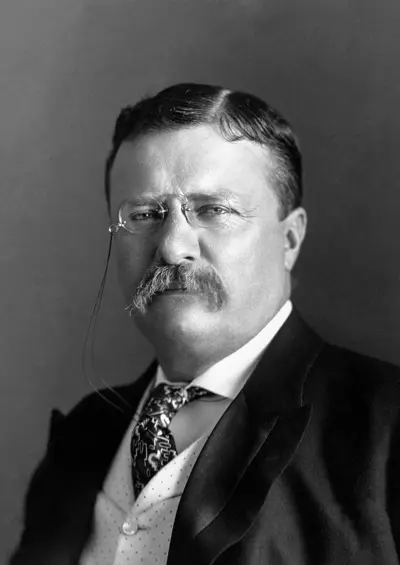
Theodore Roosevelt Jr., often referred to as Teddy or his initials T. R., was an American statesman, conservationist, naturalist, historian, and writer, who served as the 26th president of the United States from 1901 to 1909. He previously served as 33rd governor of New York from 1899 to 1900 and the 25th vice president of the United States from March to September 1901. Roosevelt emerged as a leader of the Republican Party and became a driving force for anti-trust and Progressive policies.
