Theodore Roosevelt Quotes
I don't go so far as to think that the only good Indians are dead Indians, but I believe nine out of ten are, and I shouldn't like to inquire too closely into the case of the tenth.
To many, this quotation is shocking. TR was a presidential pioneer in race relations being the first President to ever invite a Black to dine at the White House. See {588996} for his views on Blacks. Although modern and liberal with respect to most minorities, TR had a major blind spot regarding Native Americans and was among the worst racists.
Theodore Roosevelt, 1858-1919, 26th President of the United States (Republican, NY), 1886
Sourced by: Eigen's Political and Historical Quotations

As enlightened and progressive that his views on Blacks were, he was amazingly racist when it came to Native Americans. See {588991}.
Roosevelt had little respect for Miles who was an enemy of the President’s. Incredibly enough, Roosevelt wrote this sentence in a letter to the general. However, the President’s aids persuaded him not to send the letter not only because it was so confrontational with Miles but it was a Presidential admission that there had been a “massacre” for which the United States military was responsible. For a parallel situation in World War II England, see Winston Churchill {597711}. Roosevelt remembered the incident and later when Miles stepped out of line, Roosevelt ended the general’s career—see {589012}. This quotation when considered against the {588991} quotation demonstrates the very complex nature of TR’s character and views. He did not like Indians and had disparaged them and commented that dead Indians were good Indians. Yet he had a very strong sense of honor and was greatly offended by the massacre of unarmed Indians and women and children.
Earlier in his life, the President had very racist views towards the American Indian as can be seen in {588991}. However, in his regiment he organized—the Rough Riders—for the Spanish American War, there were a number of Native Americans who acquitted themselves with distinction and Roosevelt had a change of mind and heart. Further he was somewhat older and had time to reflect on the irrationality of his earlier view.
This relatively rarely quoted statement was made by Roosevelt shortly after he graduated from Harvard and was typical of the upper class racism of the day. This is the same man who would be the first to invite a Negro to dine at the White House despite media and public opinion which castigated his act; the same man who later would have several close Japanese friends and be considered very pro-Oriental. This illustrates how people can grow and develop over time—especially politicians. Many politicians with few prejudices have publicly adopted the in order to pander to populist biases of the time. Roosevelt was the opposite. He started out with the popular racism of the day and as he grew and developed, publicly led with exemplary statements and actions. See {588991} for another of his early racist statements—this one targeting Native Americans.


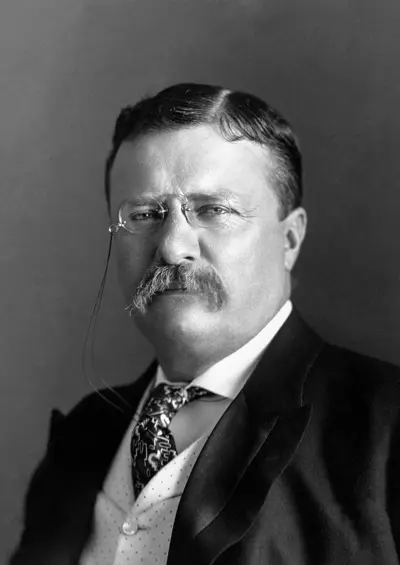
Theodore Roosevelt Jr., often referred to as Teddy or his initials T. R., was an American statesman, conservationist, naturalist, historian, and writer, who served as the 26th president of the United States from 1901 to 1909. He previously served as 33rd governor of New York from 1899 to 1900 and the 25th vice president of the United States from March to September 1901. Roosevelt emerged as a leader of the Republican Party and became a driving force for anti-trust and Progressive policies.
