PHILIP HENRY SHERIDAN

Sheridan was essentially right. With the Bison no longer available for hunting, the plains Indians had to depend on agriculture and settle on reservations or assimilate and integrate into white society. There was no specific policy to destroy the great buffalo herds, but the railroads allowed meat and the hides to be shipped East and sold for large profits for the companies who organized hunters and paid well for the buffalo. The overhunting and lack of any conservation principles soon led to the disappearance of the herds and almost made the Bison extinct. Today, we have built up some herds and they are being raised like cattle again providing meat and hides for man’s use. It is too bad that these techniques were not known then, as that could have been a terrific industry for the Indians although ranching was contrary to their then existing culture.
Prior, the Military, worked hard to enforce the Fort Laramie Treaty which gave the Lakota Sioux Indian Tribe exclusive use of the Black Hills. Bu then gold was accidentally found in the Black Hills and white miners started to illegally enter the Lakota territory. Many of them killed Indians that they ran across. See Quotation 643700. President Grant, under huge political pressure instructed General Sheridan to stop enforcing the provisions of the treaty and keep the whites out of the Black Hills. They idea was to allow the miners to clash with the Lakota who would likely defend their sacred land, and when some whites had been killed, send the army in to “pacify” the Indians and use that as a means of relegation of the Treaty so the the gold areas would bee legally accessible.
One of the must difficult ethical problems is raised in wartime, when one side uses its homes and civilian institutions to store arms and ammunition and house fighters. By international law religious institutions, hospitals, schools and homes forfeit their status when there are fighters in them or weapons are therein. For most American Indians there was no concept of military facilities as separate from civilian, unlike many Arabs of the 20th and 21st century where the military fighters deliberately choose these civilian facilities to fight from. See General Sherman’s reply {617990}.
Local Mayors have on several occasions in history used their police powers to influence the course of political events. While Mayor Daley’s police riot at the Democratic National Convention in 1968 Chicago was thought to be a unique experience, the New Orleans police—100 years earlier—had perpetrated an even more deadly riot. In this case General Sheridan was forced to impose martial law. In this case, as in Chicago, not only did the local police and politicians get away unscathed by the law, but they used the local law to actually arrest and indict the victims.
Resentment over the Southern loss of the Civil War did not dissipate. Hatred and anger were taken out on any Northerner who appeared. The local politicians not only didn’t keep the peace but they were the instigators of much of the violence and made sure that no Southerner would be convicted for violence against a Northerner. The President however, a Southerner himself, vacillated as to how to deal with the situation and lawlessness over reconstruction and race issues was encouraged throughout the South leading to almost 100 years of lynchings, Ku Klux Klan and other violence and intimidation.
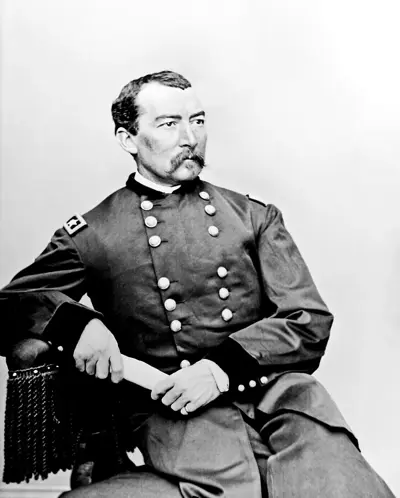
Philip Henry Sheridan was a career United States Army officer and a Union general in the American Civil War. His career was noted for his rapid rise to major general and his close association with General-in-chief Ulysses S. Grant, who transferred Sheridan from command of an infantry division in the Western Theater to lead the Cavalry Corps of the Army of the Potomac in the East. In 1864, he defeated Confederate forces under General Jubal Early in the Shenandoah Valley and his destruction of the economic infrastructure of the Valley, called "The Burning" by residents, was one of the first uses of scorched-earth tactics in the war. In 1865, his cavalry pursued Gen. Robert E. Lee and was instrumental in forcing his surrender at Appomattox.
