Philip Henry Sheridan Quotes
The only good Indian is a dead Indian.
Philip Henry Sheridan, 1831–1888, Army General, Quoted on, PBS The Civil War. April 7, 2011
Sourced by: Eigen's Political and Historical Quotations

To many, this quotation is shocking. TR was a presidential pioneer in race relations being the first President to ever invite a Black to dine at the White House. See {588996} for his views on Blacks. Although modern and liberal with respect to most minorities, TR had a major blind spot regarding Native Americans and was among the worst racists.


He was a brutal, sadistic war criminal who was assassinated by one of his many enemies in 2000 before he could be brought to trial.

Mather was urging the community to protect their children against the Devil and his band. To exemplify just how terrible Devils were to his audience, he used a comparison to the worst thing the audience was familiar with—Indians. Although there were a few examples in Colonial America of Indians being perceived as benign or even people, they were few and far between, and tended to be in New York and Pennsylvania.
Published 100 years after it was written. This is the first known written statement of what became a de facto policy regarding the American Indian.


Strictly anti-Islamic discrimination is not racism as Muslems are represented in every race and nationality in the world.
First Published American Indian Author. His last public speech. He was referring to a horrible massacre of Christian Indians and the polarizing effect that such conflicts had. Whosoever publicly castigated a massacre of whites or Indians would be met by accusations of condoning the massacres of the other side and ignoring the inevitable and natural seeking of retaliation for future protection and revenge.


See {633578} and {633579} to see some of the Sheik’s quotations on the subject.

Brant had an English style Missionary education and was an Anglican, belonging to the Church of England. During the American Revolution, he persuaded most of the Iroquois tribes to fight for the British against the revolutionary colonists. However, the Oneida tribe was not persuaded and joined the rebel side. A few New England Presbyterian missionaries had targeted the Oneida people, and when that tribe chose the “wrong” side, Brant believed that the reason was their different religious point of view. After the Revolution, Brant and his Iroquois followers were driven out of their American lands and escaped to Canada, while the Oneida were given complete title to their lands by George Washington.
Louis Farrakhan was an anti-Semitic and Black Racist.

This idea has been rejected by American Blacks from before the Civil War. There were many Black families that have been in America longer than Rockwell who always had the choice to go back to where they cam from if they were unhappy with America but they never did.

He had done an analysis of American History textbooks and found that 9 pages about American Indians and their history before and after Europeans came to America. He and most other historians consider that to be inadequate.
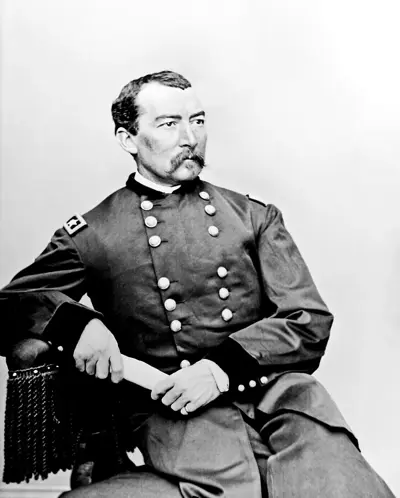
Philip Henry Sheridan was a career United States Army officer and a Union general in the American Civil War. His career was noted for his rapid rise to major general and his close association with General-in-chief Ulysses S. Grant, who transferred Sheridan from command of an infantry division in the Western Theater to lead the Cavalry Corps of the Army of the Potomac in the East. In 1864, he defeated Confederate forces under General Jubal Early in the Shenandoah Valley and his destruction of the economic infrastructure of the Valley, called "The Burning" by residents, was one of the first uses of scorched-earth tactics in the war. In 1865, his cavalry pursued Gen. Robert E. Lee and was instrumental in forcing his surrender at Appomattox.
