James Michael Cavanaugh Quotes
I will say that I like an Indian better dead than living. I have never in my life seen a good Indian (and I have seen thousands) except when I have seen a dead Indian.
James Michael Cavanaugh, 1823-1879, U.S. Congressman (Montana), Debate in the House of Representatives on the “Indian Appropriation Bill,” May 28, 1868
Sourced by: Eigen's Political and Historical Quotations

To many, this quotation is shocking. TR was a presidential pioneer in race relations being the first President to ever invite a Black to dine at the White House. See {588996} for his views on Blacks. Although modern and liberal with respect to most minorities, TR had a major blind spot regarding Native Americans and was among the worst racists.


Brant had an English style Missionary education and was an Anglican, belonging to the Church of England. During the American Revolution, he persuaded most of the Iroquois tribes to fight for the British against the revolutionary colonists. However, the Oneida tribe was not persuaded and joined the rebel side. A few New England Presbyterian missionaries had targeted the Oneida people, and when that tribe chose the “wrong” side, Brant believed that the reason was their different religious point of view. After the Revolution, Brant and his Iroquois followers were driven out of their American lands and escaped to Canada, while the Oneida were given complete title to their lands by George Washington.


He was a brutal, sadistic war criminal who was assassinated by one of his many enemies in 2000 before he could be brought to trial.


Mather was urging the community to protect their children against the Devil and his band. To exemplify just how terrible Devils were to his audience, he used a comparison to the worst thing the audience was familiar with—Indians. Although there were a few examples in Colonial America of Indians being perceived as benign or even people, they were few and far between, and tended to be in New York and Pennsylvania.
See {633578} and {633579} to see some of the Sheik’s quotations on the subject.

This quotation is often used as the greatest evidence the white usurpation of Indian land and the dubious value of all the treaties that had been made with the Indians guaranteeing them specific lands. Jackson, however, was not completely accurate. The Iroquois who fought on the American side in the Revolution were still on their lands in New York State. However, the Iriquois had their dealings with the State and local governments, and fared better than those tribes that depended in the Federal Government—especially with racists like Jackson in the Presidency.

This idea has been rejected by American Blacks from before the Civil War. There were many Black families that have been in America longer than Rockwell who always had the choice to go back to where they cam from if they were unhappy with America but they never did.


Andrew Macdonald

He was notorious for sexually abusing Hispanic women in California. He as assassinated. Most people believe that his murderer was Joaquin Murieta who was exercising “people’s justice.”

Strictly anti-Islamic discrimination is not racism as Muslems are represented in every race and nationality in the world.


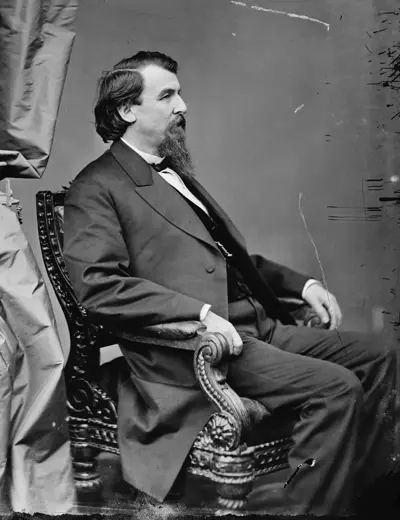
James Michael Cavanaugh was a U.S. Representative from Minnesota and a delegate from the Territory of Montana. He was born in Springfield, Massachusetts, July 4, 1823 and received an academic education. He engaged in newspaper work, studied law, and was admitted to the bar in 1854 and began practice in Davenport, Iowa. He then moved to Chatfield, Fillmore County, Minnesota, in 1854 and continued the practice of law; upon the admission of Minnesota as a State into the Union, in 1858, was elected as a Democrat to the thirty-fifth congress and served from May 11, 1858, to March 4, 1859; unsuccessful candidate for re-election in 1858 to the thirty-sixth congress; moved to Colorado in 1861 and resumed the practice of law; also engaged in mining; member of the State constitutional convention in 1865; moved to Montana in 1866; as a Democrat, he was elected a delegate to the fortieth and forty-first congresses (March 4, 1867 – March 4, 1871); unsuccessful candidate for renomination in 1870; engaged in the practice of law in New York City; returned to Colorado in 1879 and settled in Leadville, where he died October 30, 1879. He is buried in the Greenwood Cemetery in New York City.
