Philip Henry Sheridan Quotes
At a meeting which occurred in Washington on the 3d of November […] the President decided that while the orders heretofore issued forbidding the occupation of the Black Hills country by miners should not be rescinded, still no fixed resistance by the military should be made to the miners going in.... Will you therefore cause the troops in your Department to assume such attitude as will meet the views of the President in this respect.
Prior, the Military, worked hard to enforce the Fort Laramie Treaty which gave the Lakota Sioux Indian Tribe exclusive use of the Black Hills. Bu then gold was accidentally found in the Black Hills and white miners started to illegally enter the Lakota territory. Many of them killed Indians that they ran across. See Quotation 643700. President Grant, under huge political pressure instructed General Sheridan to stop enforcing the provisions of the treaty and keep the whites out of the Black Hills. They idea was to allow the miners to clash with the Lakota who would likely defend their sacred land, and when some whites had been killed, send the army in to “pacify” the Indians and use that as a means of relegation of the Treaty so the the gold areas would bee legally accessible.
William Tecumseh Sherman, Order to General Terry, 1875
Sourced by: Eigen's Political and Historical Quotations

Gold had been discovered in the Black Hills lands that were sacred to the Lakota Sioux and were reserved for exclusive use of the Indians by the Fort Laramie Treaty. Greedy whites, ignoring the treaty provisions not only entered the Black Hills to pan and mine for the gold, but killed many Indians they ran across Sherman was angry and wrote to his old friend President Grant. Grant, now a political, had to contend with public opinion that thought it absurd that gold should not be mined because a few Indians regarded the land as sacred. Meanwhile Grant was working with a few others to portray minor clashes between whites and Indians in the Black Hills as violent and dangerous Indians breaking the treaty.

The discovery started a white frenzy to prospect the Black Hills. The trouble was that the 1868 Treaty of Fort Laramie had guaranteed the Black Hills to the Lakota Sioux. The Army tried to keep the white gold seekers out, but it was too difficult and there was not great public support for honoring the treaty. So the army decided to buy the Black Hills from the Indians and open it to legal prospecting. But the Sioux refused to sell not wanting to trade their sacred land for money and having no interest in gold. So the whites broke the treaty and took the gold anyway. This led to the hostilities and the greatest Indian victory wiping out Custer and his men at the Battle of the Little Big Horn.


The general offered Geronimo a house and land to him and his followers if they surrendered. The Indian chief observed that such promises had been made and broken before by the whites. The Indians surrendered. They were shackled and deported to Florida.

Many American leaders wanted to comply with and enforce the Indian treaties, but the remoteness made it difficult. There were always those whites who did not want to be restricted by Indian treaties who took advantage of the situation when there was a leader like Clinton who wanted to enforce the treaties. However in many cases, the American leadership really did not want to enforce the treaties and in some cases, as with President Andrew Jackson, wanted to abrogate the treaties with the Indians.

“Cleaned out” meant destroyed. He had been a strong advocate of peace with whites. See {610679} .
This treaty ended Red Cloud’s War. It shows a very sophisticated attempt by the white and Indian leadership. In addition to assuring the Indians control over the Black Hills, the parties provided for economic development. A white doctor, teacher, engineer, blacksmith and other technicians were to live on the reservation and teach their trades to the Indians. The Lakota Sioux had been at war with their neighbors before the whites ever came. Hunting and war was all they knew, and this treaty would give them a chance to modernize and earn a living. Unfortunately, gold was found in the Black Hills and whites soon usurped the land breaking the treaty and undoing the progress that had been made. Then the whites seized and confiscated the Sioux land in violation of the treaty and the Government was later ordered to pay $105 million by the courts. The Indians however did not want the money—a fortune then; they wanted their land back.
The Iroquois were among the most sophisticated of the North American Indian Tribes. They also were highly assimilated into the American society. In the next decades, they would switch their political position when New York State provided better legal guarantees for Iroquois land than the Federal Government. By the end of the 20th Century, led by the Iroquois, the Indian residents of New York State had the same level of earnings as the white man—and that was with NO INDIAN GAMING.

Samuel Langhorne Clemens, 1835-1910


This law allowed the President to forcibly move entire tribes from their native lands to sparsely settled land in the West. Oklahoma became knows as Indian Territory as so many Indians were relocated there. The act, and this clause in particular, gave the President the authority over all Indian tribes in the nation and established the difficult if not impossible relationship between the Indian nations and the Federal government. The act—the last sentence of the quote—also ratified all treaties with the Indians and pronounced them inviolate. That was not to be.

Despite Jefferson’s reasonable intentions towards the Indians, all the boundaries never did get fixed and existing agreements and treaties were abrogated usually by whites acting illegally but then were supported by their state government and if serious hostilities broke out, the Federal government usually entered the fray to defend the whites regardless of whether or not they abrogated the treaties. Some Indian nations complicated the situation by having a tradition of raiding neighbors and stealing horses or other goods. Whites, insisting on then rather severe “English type” law enforcement often inadvertently, started an Indian war with the Federal soldiers almost always defeating the Indians leading to yet another treaty by which the Indians were pushed from their land, Further, many whites “bought” lands from Indians in good faith while the Indians did not own the lands, thought that they were selling hunting rights as they had no tradition of property ownership. The consequence was tragic history which Jefferson and his successors failed to manage well.
His negative predictions were tragically prescient.

In 1832 the Supreme Court held that the state of Georgia could not remove Creek and Cherokee Indians from lands that had been guaranteed to them by a federal treaty. The president disagreed with the court, then headed by John Marshall:. Marshall could not do so without the executive. The Indians were illegally removed to Western lands.

The Cherokee's had fallen under the control of the Confederate military and Ross had urged Federal military protection for the tribe.
In a tragic irony, the two chiefs were killed by a year later at the Sand Creek Massacre.

The General Court was then the legislature.

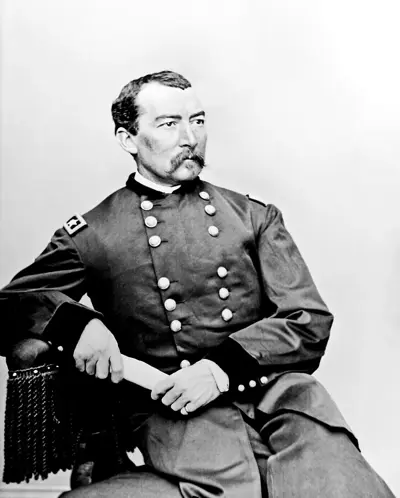
- Born: March 6, 1831
- Died: August 5, 1888
- Nationality:
- Profession:
Philip Henry Sheridan was a career United States Army officer and a Union general in the American Civil War. His career was noted for his rapid rise to major general and his close association with General-in-chief Ulysses S. Grant, who transferred Sheridan from command of an infantry division in the Western Theater to lead the Cavalry Corps of the Army of the Potomac in the East. In 1864, he defeated Confederate forces under General Jubal Early in the Shenandoah Valley and his destruction of the economic infrastructure of the Valley, called "The Burning" by residents, was one of the first uses of scorched-earth tactics in the war. In 1865, his cavalry pursued Gen. Robert E. Lee and was instrumental in forcing his surrender at Appomattox.
