Little Bear Quotes
The Black Hills are the house of gold for our Indians.
Little Bear, *, Sioux Indian Chief, Statement, 1870’s, Quoted in American Heritage, July/August 1996
Sourced by: Eigen's Political and Historical Quotations

Gold had been discovered in the Black Hills lands that were sacred to the Lakota Sioux and were reserved for exclusive use of the Indians by the Fort Laramie Treaty. Greedy whites, ignoring the treaty provisions not only entered the Black Hills to pan and mine for the gold, but killed many Indians they ran across Sherman was angry and wrote to his old friend President Grant. Grant, now a political, had to contend with public opinion that thought it absurd that gold should not be mined because a few Indians regarded the land as sacred. Meanwhile Grant was working with a few others to portray minor clashes between whites and Indians in the Black Hills as violent and dangerous Indians breaking the treaty.


He was referring to the fact that he had blocked the Meech Lake Accord preventing the Canadian Constitution being amended to recognize French-Speaking Quebec as a separate nation within Canada, but ignoring the Indians.


By 1887 the government behavior towards Indians had come far from the Andrew Jackson days of Indian Removal and the government and reformers were trying to do better with Indian policy. This law was very well intended, and yet angered some Indians and tribes Where there was good agricultural or grazing land, the law required that the land be divided amongst the individual Indians who would thereafter own the deed and control the land. The problem had been that there was no concept of individual land ownership in most tribes. There were no deeds and whites would buy land unknowingly (and sometime knowingly who claimed to (or did) speak for the tribe. With this law, farm and grazing land would pass to the ownership of individual Indians. There are over 500 different Indian tribes—nations in America and they are very diverse. This law was good for some tribes and negative for others. With no communal say in the use of the land, the reservation was like a white farming community where the individual was dominant and not the town, group or culture. It minimized the dependency that Indians had on each other and the group. Within individual tribes there were often those Indians who preferred collective ownership and those who preferred individual ownership as provided in this legislation.

This quotation is often used as the greatest evidence the white usurpation of Indian land and the dubious value of all the treaties that had been made with the Indians guaranteeing them specific lands. Jackson, however, was not completely accurate. The Iroquois who fought on the American side in the Revolution were still on their lands in New York State. However, the Iriquois had their dealings with the State and local governments, and fared better than those tribes that depended in the Federal Government—especially with racists like Jackson in the Presidency.
His specialty was early American history. The early colonists believed that the Indians in America were descended from the lost tribe of the Jews. Therefore, they saw it as their duty to educate them and bring them into the Christian fold, as they had never yet had the chance. Harvard in its earliest days had what and Indian students. King Phillip’s War with some Indians had soured the views of many whites and soon Harvard adopted an all white policy.


Wayne played so many parts depicting whites in the process of expanding Westward that many people saw him as an expert on the history of the Westward Expansion. He did not comment on the whites who then kept huge ranches “selfishly” for themselves or those who selfishly would not share the mineral rich land that they had taken with anyone including the original Indian owners. So in this view, the Indians should have not been capitalists but they should have been socialists and shared their resources.


He had done an analysis of American History textbooks and found that 9 pages about American Indians and their history before and after Europeans came to America. He and most other historians consider that to be inadequate.
The whites had constantly encroached on the Cherokee land which was too large for any reasonable patrolling by the Indians themselves. The Federal government persuaded the Cherokee to sign a treaty by which the Indians would give up their title to the larger part of their land. The most important quid pro quo was that the Federal Government would protect the remainder of the Cherokee land from incursion by whites or even other Indians. However, whites who coveted the land started to encroach and build farms and ranches. The Federal government was reluctant to use American soldiers against American citizens and was looking for a way out. However, the Cherokee chiefs were reminding them of their obligation. The state governments were less concerned about Federal treaties, and Georgia passed a law that said that all the Cherokee land must be governed by State Law contrary to the Treaty which gave the Cherokee total sovereignty. But the Feds were not anxious to have a showdown with the states on this issue. Whites, with the connivance of the state governments and the support of some Federal Officials offered to amend the treaty with the Cherokee. The whites would pay the Indians fair market value for their land in the East. The Federal Government would provide equal amount of land in the Indian Territory of Oklahoma, then a territory. The Feds would assist with the relocation and provide troops to protect the Cherokee from thieves and raiders—whites and Indians, and would guarantee that the Cherokee would be completely sovereign in the new land. The chief’s did not want to renegotiate the old treaty—they just wanted it enforced. The Supreme Court ruled in their favor, but President Jackson, ignored the ruling and forced the Cherokee onto the Trail of Tears for Oklahoma and the whites took over the valuable Cherokee land.


Earlier in his life, the President had very racist views towards the American Indian as can be seen in {588991}. However, in his regiment he organized—the Rough Riders—for the Spanish American War, there were a number of Native Americans who acquitted themselves with distinction and Roosevelt had a change of mind and heart. Further he was somewhat older and had time to reflect on the irrationality of his earlier view.

Prior, the Military, worked hard to enforce the Fort Laramie Treaty which gave the Lakota Sioux Indian Tribe exclusive use of the Black Hills. Bu then gold was accidentally found in the Black Hills and white miners started to illegally enter the Lakota territory. Many of them killed Indians that they ran across. See Quotation 643700. President Grant, under huge political pressure instructed General Sheridan to stop enforcing the provisions of the treaty and keep the whites out of the Black Hills. They idea was to allow the miners to clash with the Lakota who would likely defend their sacred land, and when some whites had been killed, send the army in to “pacify” the Indians and use that as a means of relegation of the Treaty so the the gold areas would bee legally accessible.


Miller was the first Black American admitted to a Graduate Program—Johns Hopkins—in Mathematics
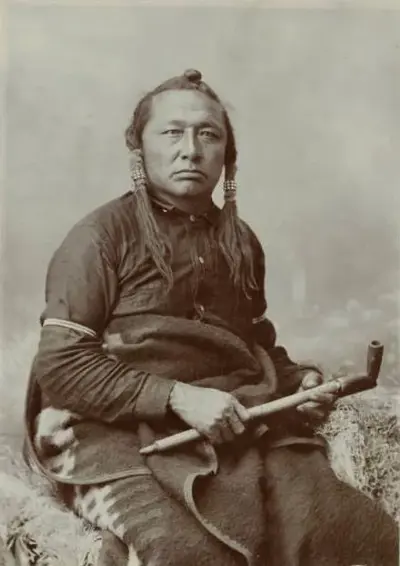
Little Bear (born Ayimâsis or Macquettoquet) was a Cree leader who lived in the District of Alberta, Idaho Territory, Montana Territory, and District of Saskatchewan regions of Canada and the United States, in the 19th and early 20th centuries. He is known for his participation in the 1885 North-West Rebellion, which was fought in Alberta and Saskatchewan.
