Charles Dilke Quotes
If gold was found anywhere on the globe, that region would shortly be governed by English speakers.
Charles Dilke, 1789-1864, British Member of Parliament (Liberal), ~1850
Sourced by: Eigen's Political and Historical Quotations


When the British first colonized South Africa, the area they used was akmost uninhabited or very sparcely so. However, some Black tribes (including the Zulus) were moving from the north and themselves were colonizing or annexing the areas to their kingdom. The British were most interested in Trading so did not have large land asperations. The Dutch white Boer Africanners, in contrast, wanted to farm the lands and use the range for their cattle. They wanted the land. The English policy was that there would be friendly relations with the Black tribes surrounding their Cape Colony and no one should take their land. However the Boers started attacking the Black areas and seizing their farms and villages. At first, the English assumed that the Blacks would easily be able to ward off the invasion as the Afrikanners had no professional troops like the British. However, the neighboring tribes were not very warlike or good fighters. They were being overrun by the Zulus coming from the North and the Boers from the South. The British Government had a real problem in that they would have to have British soldiers fight the white Afrikanners if they wanted to stop the illegal white invasions. This was the root of the Boer War where the British would be fully at war with the Africanners.


The title of this controversial poem became a rallying cry for imperialists and anti-imperialists both. The imperialists saw it as a justification for expansionism and colonialism—that the white had a moral responsibility to bring civilization to the other races. To the anti-imperialists it was a racist justification for imposing Christian values on the rest of the world which didn’t want them. In the quotation example here, the poem was used to state a dilemma of foreign aid and trying to bring democracy and freedom to the world.

Bismarck articulated this throughout the German government and provided cogent reasoning as to why colonialism was a counter-productive policy. History shows him to be prescient about the difficulties of Empire. Nonetheless, in the mad scramble of the European powers for Africa, and the public opinion weighing in cavor of Empire, Germany got sucked in just like the others and Bismarck reluctantly changed his policies. He was right the first time.

In 1832 the President sent Edmund Roberts, a New Hampshire sea captain, to arrange commercial treaties with Asian countries such as Burma, Indo-China, Siam and Japan:


He was one of the last generation of military officers who did not have the education, training, and political sophistication to avoid picking one of the several factors for going to war, and making it seem that that was the most important or only one. Oil is always a factor in the Middle East, but there were other major causes for our going to war.


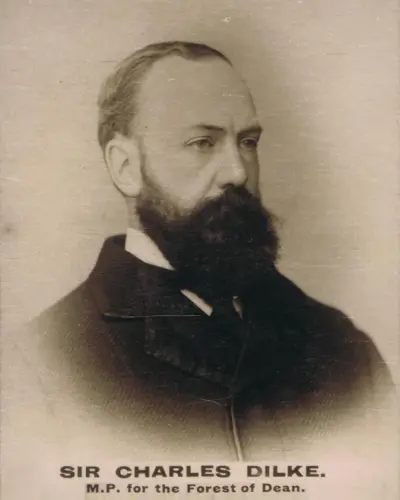
Sir Charles Wentworth Dilke, 2nd Baronet, PC was an English Liberal and Radical politician. A republican in the early 1870s, he later became a leader in the radical challenge to Whig control of the Liberal Party, making a number of important contributions, including the legislation increasing democracy in 1883–1885, his support of the growing labour and feminist movements and his prolific writings on international affairs.
