Philip Henry Sheridan Quotes
In taking the offensive I have to select that season when I can catch the fiends; and if a village is attacked and women and children killed, the responsibility is not with the soldiers, but with the people whose crimes necessitated the attack.
One of the must difficult ethical problems is raised in wartime, when one side uses its homes and civilian institutions to store arms and ammunition and house fighters. By international law religious institutions, hospitals, schools and homes forfeit their status when there are fighters in them or weapons are therein. For most American Indians there was no concept of military facilities as separate from civilian, unlike many Arabs of the 20th and 21st century where the military fighters deliberately choose these civilian facilities to fight from. See General Sherman’s reply {617990}.
Philip Henry Sheridan, 1831-1888, Army General & Reconstruction Official, Letter to his superior, General William Tecumseh Sherman
Sourced by: Eigen's Political and Historical Quotations


The Creeks—the Cherokee traditional rivals and enemies were under a different command but all the other Indians were under Stand Watie’s command. In this quotation, we see the negative reaction that many Southerners had toward Quantrill and his cutthroats. This quote and others show that the Quantrill atrocities were generally known throughout the South. The Confederate command structure however, did nothing to rein in Quantrill’s atrocities much less discipline him for his war crimes. It is not clear to whom Waite referred as “enemies”—the Union troops or the Creeks, their traditional enemies. The slavery issue of the Civil War divided more than the nation. The Cherokee’s were badly divided over social class, aristocracy, strategy in keeping their land and tribal sovereignty, and slavery. A number of the older families had Black slaves. Stand Waite was one of the old, traditional, Cherokee, families, who were not happy losing their traditional power and influence when Jon Ross was elected tribal leader. He and his majority faction would not support the South in the Civil War. Stand Waite did, and after Ross was murdered Waite became the Second Cherokee Tribal leader.


Over the years Sherman’s advocacy of Indian extermination went beyond the Sioux to all Indians.


Cromwell’s army of Parliament massacred all the town’s defender. Cromwell had issued an ultimatum to the town commander which had been refused. See {632367}.

In addition to facing regular Confederate Troops, there were irregular insurgents who would fire at and harass normal civilian activity much like the terrorists in the Mideast today. Like today, the insurgents could exist only as long as they were sheltered and assisted by the Southern civilian population. Sherman did not see this as collective punishment as all the people in the small town of Randolph were helping the insurgents.

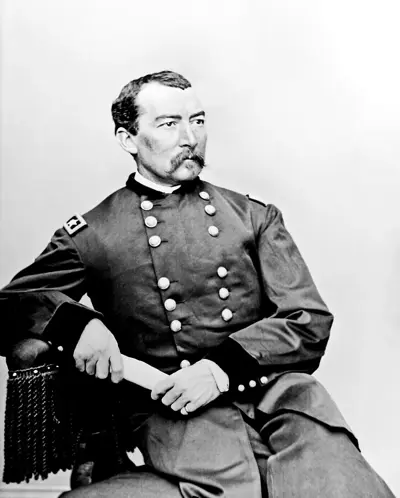
- Born: March 6, 1831
- Died: August 5, 1888
- Nationality:
- Profession:
Philip Henry Sheridan was a career United States Army officer and a Union general in the American Civil War. His career was noted for his rapid rise to major general and his close association with General-in-chief Ulysses S. Grant, who transferred Sheridan from command of an infantry division in the Western Theater to lead the Cavalry Corps of the Army of the Potomac in the East. In 1864, he defeated Confederate forces under General Jubal Early in the Shenandoah Valley and his destruction of the economic infrastructure of the Valley, called "The Burning" by residents, was one of the first uses of scorched-earth tactics in the war. In 1865, his cavalry pursued Gen. Robert E. Lee and was instrumental in forcing his surrender at Appomattox.
