George Bernard Shaw Quotes
Soldiering … is the coward's art of attacking mercilessly when you are strong, and keeping out of harm's way when you are weak. That is the whole secret of successful fighting. Get your enemy at a disadvantage; and never, on any account, fight him on equal terms
George Bernard Shaw, 1856-1950, Irish Nobel Laureate in Literature, Arms and the Man
Sourced by: Eigen's Political and Historical Quotations

ground troops fighting in Iraq & Syria in addition to air power Quote A was made in June of 2014. Quote B, 3 months later in September. In June there are rumors that the Obama administration might commit more military assets to the situation in Iraq and Syria and Graham was afraid that the President might be considering ground troops. Three months later, President Obama announced a policy of making a serious military commitment to the area, but stated that he would not be using ground troops. Graham then criticized the President for NOT deploying ground troops reversing his previous position. This is a marvelous example of the hyper partisanship and the virulent anti-Obama action by the Republicans. Actually, Graham was better than most of the Republicans. He was always polite. He criticized the President’s policies and actions even if he had to twist around to do it. Many of his colleagues made vicious personal attacks on the President and kept spreading rumors that he was not a Christian but a Muslim who was not born in America and was indoctrinated in Islam as a boy. Graham’s flip flop was explained by him as a change that was made necessary by the rise and military aggression of ISIS which he also blamed on the President for not committing more resources to the Syrian insurgents.

He had wanted more troops for the Afghan War than President Obama would approve. The Republican members of the Congress tried to make the difference a major issue of a President not supporting his commanders. The General made this brilliant response.


One of the must difficult ethical problems is raised in wartime, when one side uses its homes and civilian institutions to store arms and ammunition and house fighters. By international law religious institutions, hospitals, schools and homes forfeit their status when there are fighters in them or weapons are therein. For most American Indians there was no concept of military facilities as separate from civilian, unlike many Arabs of the 20th and 21st century where the military fighters deliberately choose these civilian facilities to fight from. See General Sherman’s reply {617990}.

See {613496} for the origin of the “thrashing a cannibal” phrase.


As an educational and military leader, he saw the importance of each in a nation’s welfare.


This is not the most common view military view which tends to place the senior officers out of harm’s way as they are “too valuable” to become casualties. Among modern armies, Israel stands out as having the same leadership doctrine as Genghis Khan. Those who attack Israel and lose, never have their commanders at the front of the battle. Israel does.

This seemingly prosaic quotation is one of the most significant quotations in history. At the outbreak of the Civil War, the telegraph was rapidly developing as a communications technology. One of Lincoln’s greatest achievements was the appreciation of the new technology and the deployment of it to gain an immense strategic advantage which was a major factor in all warfare thereafter. Lincoln placed ALL telegraphy of the North under the control of the military. He then had a telegraph terminal installed in the War Department right next to the White House. He would spend many hours in the Telegraph Room reading dispatches as they were coming in. To the distress of some of his military commanders, the Commander in Chief actually, for the first time in history, received virtually real time intelligence about a battle, and issued orders to the commanders in the field in real time. The quotation is one of the early examples. Ironically, Lincoln had more real time battlefields information in the Civil War than most of our Presidents did until the Vietnam War when digital, radio communications were exploited for the purpose.


Although this may seem obvious to most, there has been, in recent years, an attempt by some to introduce the concept of proportionality into the war equation and definition of war crime. Defense after attack many argue should be proportional to the attack. So if Nation A shoots down a plane of Nation B, according to this logic Nation B is not supposed to invade nation A. Brecher points out the absurdity of the concept from a war point of view. It is however used by many to criticize the defenses against terrorism where modern weapons are used against terrorists and those that harbor them.


The First World War had recently ended with the mass of horrible casualties that resulted from the use of poison gas. Permanently debilitated veterans were trying to rebuild a life all over England. Many Englishmen wanted to ban English use of poison gas. Churchill objected as the Middle East was a cauldron of various forms of terrorism then in areas that the British were “responsible for” under the Peace Treaty. He argued that there was little difference be gas and shells, but that did not persuade many others. Churchill was outvoted and overruled and the British have never used poison gas since although they had a large supply and were prepared to use it in WWII if the Germans did. This quotation was a blot on Churchill’s reputation. One issue was whether or not it was human to use poison gas. Churchill was willing to say no where white Christians were concerned but was perfectly willing to use them on the “uncivilized”.

Later, he felt that the offense had become almost invincible. See {626741}. Tesla was one of the great American immigrant scientists. He found in America the kind of intellectual and operational freedom that did not exist in the rigid, monarch-controlled, Austro-Hungarian Empire. He developed patents and techniques that formed the technological bases of radio, telephone long distance, TV, cell phones, Wi Fi, just to name a few. Most important he was Thomas Edison’s great nemesis. Edison invented DC electric generators that could power factories or entire streets in a neighborhood. Tesler invented and developed AC electrical technology which could power entire cities and he could move electricity over long distances which Edison could not. Tesler was one of the first scientists to conceive of and try to implement “Big Science” where there were huge capital investments to develop machines and systems to do what had never been done before—philosophically like the CERN Hadron Collider. Tesler even convinced a large corporation to finance the construction of a massive building and tower so he could experiment with the wireless transmission of electricity. However, as the industrial democracies have learned, Big Science can only be funded by governments and it often takes sever working in consort to afford the huge investment that is required. In Tesler’s era, the federal and state governments did not fund scientific research so his work was not only technically ahead of his time but also conceptually. He anticipated most of the problems and need for a national power grid that was challenging America even at the beginning of the 21st century.


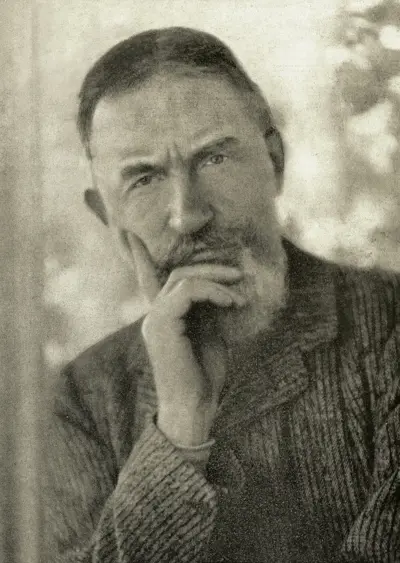
George Bernard Shaw, known at his insistence simply as Bernard Shaw, was an Irish playwright, critic, polemicist and political activist. His influence on Western theatre, culture and politics extended from the 1880s to his death and beyond. He wrote more than sixty plays, including major works such as Man and Superman (1902), Pygmalion (1912) and Saint Joan (1923). With a range incorporating both contemporary satire and historical allegory, Shaw became the leading dramatist of his generation, and in 1925 was awarded the Nobel Prize in Literature.
