William Tecumseh Sherman Quotes
I will back you with my whole authority... I will say nothing and do nothing to restrain our troops from doing what they deem proper on the spot, and will allow no mere vague general charges of cruelty and inhumanity to tie their hands, but will use all the powers confided to me to the end that these Indians, the enemies of our race and of our civilization, shall not again be able to begin and... carry out their barbarous warfare.
William Tecumseh Sherman, 1820-1891, General of the Army, Response to a letter of one of his Generals, Phil Sheridan. [See {49984}.]
Sourced by: Eigen's Political and Historical Quotations

One of the must difficult ethical problems is raised in wartime, when one side uses its homes and civilian institutions to store arms and ammunition and house fighters. By international law religious institutions, hospitals, schools and homes forfeit their status when there are fighters in them or weapons are therein. For most American Indians there was no concept of military facilities as separate from civilian, unlike many Arabs of the 20th and 21st century where the military fighters deliberately choose these civilian facilities to fight from. See General Sherman’s reply {617990}.

He was a brutal officer who by modern standards committed various war crimes.

Self Given Title. The governor distinguished between friendly Indians from others to the consternation of Bacon and his followers.

The Seminole Wars were one of the low points in American military behavior. With the specific permission of Commanding General Jesup, the soldiers were to loot the homes and personal possessions of the enemy civilians as well as fighters, but he favored extermination and there were many atrocities. He even seized the Seminole Leaders who had been invited for Peace Talks.


In April 1832, Black Hawk led his warriors into Illinois to recapture their ancestral lands. The attempt was thwarted by American Army and Navy forces, and Black Hawk surrendered. Several months later he was sent East to meet with President Andrew Jackson. At that meeting, Black Hawk told the President:

Thunder Rolling Down the Mountain


Some Mexicans have always resented the U. S. for “colonizing” Arizona and other territory that once belonged to Mexico. This quotation is very revealing concerning the reality on the ground. The Apache were on the land when the Mexicans moved in to “civilize” the territory. However, the Apache, by violence, drove the Mexicans out. At that point the Mexicans were happy to sell Arizona to the Americans and the Gadsden Purchase brought Arizona to the United States as a territory. The Americans however didn’t buy the land from the Apache, the owners before the Mexicans claimed it. Many Apaches continued the violence against whoever tried to settle in the area. Eventually, the Americans accomplished what the Mexicans did not—militarily subduing the Apache.
Published 100 years after it was written. This is the first known written statement of what became a de facto policy regarding the American Indian.


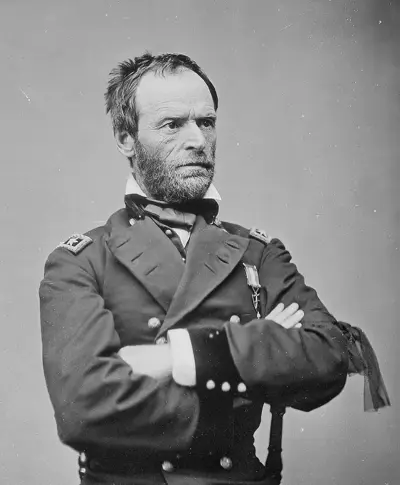
- Born: February 8, 1820
- Died: February 14, 1891
- Nationality: American
- Profession: Soldier
William Tecumseh Sherman was an American soldier, businessman, educator, and author. He served as a general in the Union Army during the American Civil War (1861–1865), receiving recognition for his command of military strategy as well as criticism for the harshness of the scorched earth policies he implemented in conducting total war against the Confederate States. British military theorist and historian B. H. Liddell Hart declared that Sherman was "the first modern general".
