Black Hawk Quotes
We did not expect to conquer the whites. I took up the hatchet to revenge the injuries which my people could no longer endure. Had I borne them without striking, my people would have said - "Black Hawk is a woman; he is too old to be a chief; he is no Sauk.
In April 1832, Black Hawk led his warriors into Illinois to recapture their ancestral lands. The attempt was thwarted by American Army and Navy forces, and Black Hawk surrendered. Several months later he was sent East to meet with President Andrew Jackson. At that meeting, Black Hawk told the President:
Black Hawk, 1767-1838, Sac and Fox Indian Chief, Autobiography
Sourced by: Eigen's Political and Historical Quotations

This editorial was written just after the Massacre of Wounded Knee. An irony is that this editor who called for the extermination of Native Americans was later the author of The Wizard of Oz.


The invasion failed, Hull lost even Detroit and the Michigan territory and was later court-marshaled.

The quotation is actually combined from two different speeches, July 28 and August 21, 1725. The dependency on guns and gunpowder was one of the key elements that was creating the dependency. See {613048}.

Enemy captives were sometimes adopted by Indian families to replace a lost loved one.


They stopped and a massacre was averted.

The French had launched a sneak attack on the English settlement at Schenectady, NY. The English had not provided enough security to Schenectady and now considered withdrawing from the upstate area. Contrary to the popular conception of all the Indians being invaded by the Whites and fighting it, here these Indians were urging the English to hang on and stay in the area. The Mohawk were one of the tribes of the Iroquois confederation which were very sophisticated, somewhat democratice, and very powerful economically and militarily. To them, the English were good trading partners and unlike the French tended to conform with Iroquis norms, rules and mores. It also illustrated the closeness of the alliance of these Indians with the English against the French in the French & Indian Wars.


He was a brutal officer who by modern standards committed various war crimes.


Two months earlier, Jinnah and the Muslim League had, behind the scenes, orchestrated and abetted vicious, murderous, terrorist attacks on Sikhs by Muslim tribesman brought into the Punjab for the purpose." Master Tara Singh

He was a brutal, sadistic war criminal who was assassinated by one of his many enemies in 2000 before he could be brought to trial.

Just like Spain and Persia, the Arabs by fighting lost not only more land, but also lost the respect of most of the non-Muslim War. The conscious decision to choose an irrational strategy that would cause loss of life, land and respect has none-the-less repeatedly been chosen by the Arab culture. much to its detriment. Azzam is one of the few Arabs to admit this to the non-Islamic World.

The Indian allies of the French scalped some American colonists which for some whites was akin to the modern reaction to terrorist atrocities. The British and Americans then justified the scalping of their Indian allies as simple retaliation. While Indians had scalped before the whites ever came, the whites accelerated the practice. There was an economic element to scalping. The French “paid” their Indian allies in arms, blankets, trinkets and alcohol by the scalp as it was a crude way of “performance measurement.” Not to be outdone, the English adopted the same custom with the French allied Indians as targets. In North Carolina, for example, the “volunteer” rangers were paid the enormous rate of 10 pounds a scalp.
Oliver was the judge who tried the British Soldiers after the Boston Massacre. Most Americans believe that scalping was an Indian barbarity. Although it was new to the European colonists who came to America, they quickly adopted the practice and had similar cultural and macho symbols associated with scalps. This is one of the many eyewitness descriptions of the Whites and their scalping. The barbarity was practiced by White and Indian alike.

First Published American Indian Author. His last public speech. He was referring to a horrible massacre of Christian Indians and the polarizing effect that such conflicts had. Whosoever publicly castigated a massacre of whites or Indians would be met by accusations of condoning the massacres of the other side and ignoring the inevitable and natural seeking of retaliation for future protection and revenge.
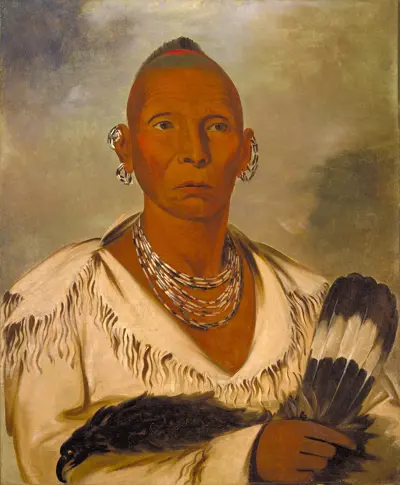
Black Hawk, born Ma-ka-tai-me-she-kia-kiak, was a band leader and warrior of the Sauk Native American tribe in what is now the Midwest of the United States. Although he had inherited an important historic sacred bundle from his father, he was not a hereditary civil chief. Black Hawk earned his status as a war chief or captain by his actions: leading raiding and war parties as a young man and then a band of Sauk warriors during the Black Hawk War of 1832.
