Logan Quotes
I appeal to any white man to say, if ever he entered Logan's cabin hungry, and he gave him not meat; if ever he came cold and naked, and he clothed him not. During the course of the last long and bloody war, Logan remained idle in his cabin, an advocate for peace. Such was my love for the whites, that my countrymen pointed as they passed, and said, Logan is the friend of the white men. I have even thought to live with you but for the injuries of one man. Col. Cresap, the last spring, in cold blood, and unprovoked, murdered all the relations of Logan, not sparing even my women and children. There runs not a drop of my blood in the veins of any living creature. This has called on me for revenge. I have sought it: I have killed many: I have fully glutted my vengeance. For my country, I rejoice at the beams of peace. But do not harbor a thought that mine is the joy of fear. Logan never felt fear. He will not turn on his heel to save his life. Who is there to mourn for Logan? Not one.
Logan was considered a great orator by Indians and whites alike. See {620551} .
Logan, ~1723–1780, Mingo Indian Chief, “Lpgan’s Lament”, Speech at the end of the Dunmore's War
Sourced by: Eigen's Political and Historical Quotations

Logan was a chief of the Mingo tribe, an offshoot of the Iroquois nation. He was a great orator.


Quintus Horatius Flaccus

Over the years Sherman’s advocacy of Indian extermination went beyond the Sioux to all Indians.
Sherman, one of the most gifted generals of the Civil War. He hated the cruelty of war and the Civil War in particular as he had specifically warned his Southern friends ahead of time about what war would bring. See {585882}. Sherman was one of the first American military men to look at war without any of the romantic, patriotic, noble attributes that most others did.

Nathaniel Bacon had led a rebellion in Virginia and had routed the Governor’s troops and caused him to flee leaving control of Virginia to Bacon and his followers who were far more democratic and advanced. However Bacon succumbed to swamp fever, and his followers could not hold the colony together giving the Governor a chance to establish his authority. He then went on a vengeful reign of terror, executing all of Bacon’s followers he could get his hands on. With no danger to the authority of the Crown, King Charles felt that Berkeley had gone too far. The King’s father Charles I had been executed in the aftermath of the English Civil War, but he had executed far fewer than Berkely had done in Virginia.

Generally after civil wars there have been extensive reprisals and trials of the winning side against the losing one. Lincoln was determined that this pattern not be followed as the bloody war was coming to an end. Ironically, Andrew Johnson, Lincoln’s successor and a Southerner, was, together with some of the Radical Republicans, in favor of trying many of the Southern leaders for treason and rebellion. Lincoln’s view however and that of the moderate members of Congress prevailed. However, the Southern Whites generally would not comply with the Constitutional Amendments and laws regarding the role of the Negro, and Johnson was very sympathetic to their racism which led to a conflict between Johnson and Congress.


At Tippecanoe, General Harrison defeated the Indians but suffered over 60 of his men killed and many more wounded. Newly supplied modern English weapons were found on captured Indians. There was a call for war with England:

In 1877 Gen. O. O. Howard and 600 men fought Chief Joseph and his Nez Perce warriors near Kamiah, Idaho. Outnumbered and outflanked, Chief Joseph headed his band toward the Canadian border, but before they reached it they were captured. Chief Joseph's surrender speech was recorded by General Howard's adjutant: Thunder Rolling Down the Mountain


The President had earlier threatened to execute Confederate prisoners, if the South implemented its threat to execute any Union Negro soldiers they captured. The threat seems to have worked. See Lincoln.

Enemy captives were sometimes adopted by Indian families to replace a lost loved one.


Attila the Hun


The Abenaki Indians from Canada had come South and raided many of the settlements of upstate New York. In the process, they committed many atrocities killing civilian men, women and children. Amhurst ordered Robert Rogers and his rangers to attack the Abenaki home villiage in Canada on a famous punitive raid. The Rangers, did indeed, raid the Abenaki and wiped out all the males of the tribe that were in the camp at the time. Amhurst hated Indians, but still had his standards regarding the killing of women and children, but was perfectly willing to kill all the mature males. There were no Geneva Conventions at the time. The same general introduced biological warfare by giving Indians smallpox infected blankets. See {619646}

Roger’s Rangers of the French & Indian War were the first using unconventional warfare and invented the “deep raid” when they went in stealth all the way to Quebec and defeated the Abnaki Indians in their home village rather than defend against the Indians’ French coordinated attacks on upper York State. Rogers was portrayed by Spencer Tracy in the film Northwest Passage depicting the raid. All the men were killed but the women and children were captured and released with the exception of 5 teenagers who the Rangers took with them. This was one of the first formal “Rules of War” in what was otherwise a viciously uncivilized war.


Lawrence was a thriving community of abolitionists. Quantrill’s irregular force generally murdered prisoners, scalped them, mutilates their bodies, and wore scalps and body parts as clothing decoration. Quantrill “cleansed” Lawrence by burning virtually every building and killing the male population, See {617769}. It has been a source of great argument as to whether the Confederate command and politicians were fully aware of his actions and endorsed them or didn’t know. Since many of his escapades were printed in the Newspapers of the day, it is probably the case that the Confederate authorities had so much to do, that they just didn’t want to determine the truth of the accusations.
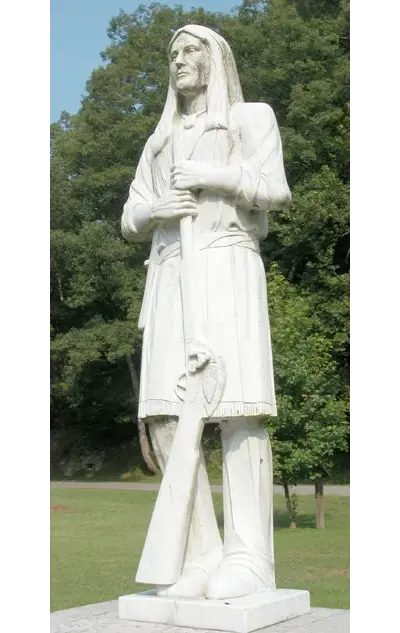
Logan the Orator (c. 1723–1780) was a Cayuga orator and war leader born of one of the Six Nations of the Iroquois Confederacy. After his 1760s move to the Ohio Country, he became affiliated with the Mingo, a tribe formed from Seneca, Cayuga, Lenape and other remnant peoples. He took revenge for family members killed by Virginian Long knives in 1774 in what is known as the Yellow Creek Massacre. His actions against settlers on the frontier helped spark Dunmore's War later that year.
