John Marshall Quotes
At the time the Constitution was framed, the idea of appealing to an American court of justice for an assertion of right or a redress of wrong had perhaps never entered the mind of an Indian or of his tribe. Their appeal was to the tomahawk, or to the Government.
John Marshall, 1755-1835, Chief Justice of the U. S. Supreme Court, U. S. Congressman (Federalist, VA), U. S. Secretary of War, U. S. Secretary of State, Cherokee Nation v. Georgia, 1831
Sourced by: Eigen's Political and Historical Quotations


He was a brutal officer who by modern standards committed various war crimes.


Self Given Title. The governor distinguished between friendly Indians from others to the consternation of Bacon and his followers.

In April 1832, Black Hawk led his warriors into Illinois to recapture their ancestral lands. The attempt was thwarted by American Army and Navy forces, and Black Hawk surrendered. Several months later he was sent East to meet with President Andrew Jackson. At that meeting, Black Hawk told the President:


Published 100 years after it was written. This is the first known written statement of what became a de facto policy regarding the American Indian.


The first Native American to become a General Officer. Appointed by President Grant in 1869

The invasion failed, Hull lost even Detroit and the Michigan territory and was later court-marshaled.


The Cherokee's had fallen under the control of the Confederate military and Ross had urged Federal military protection for the tribe.
The quotation is actually combined from two different speeches, July 28 and August 21, 1725. The dependency on guns and gunpowder was one of the key elements that was creating the dependency. See {613048}.

The legal and governmental relationships with the Indians has from the very beginning of the nation been very complex and difficult. The Articles of Confederation had been wholly inadequate to the task and there were attempts to remedy this in the Constitution. There was an improvement but the problems still remain and may never be fairly and reasonably resolved.


Note that there was still a serious attempt to coexist with the Indians and to pay for lands that whites moved into. This would change radically in the administration of Andrew Jackson who would replace Adams.

The Indians did not have the wheel when the whites came, but soon there were wagons, stage coaches and railroads.
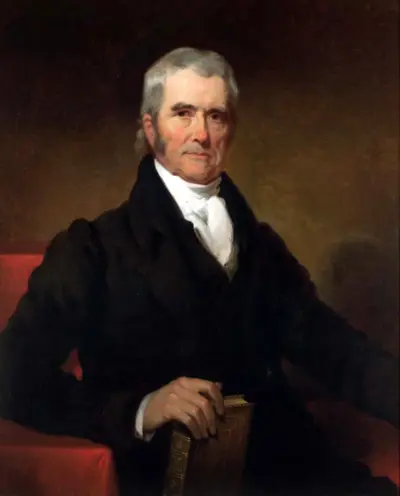
John Marshall was an American politician and lawyer who served as the fourth Chief Justice of the United States from 1801 to 1835. Marshall remains the longest-serving chief justice and fourth-longest serving justice in Supreme Court history, and he is widely regarded as one of the most influential justices to ever sit on the Supreme Court. Prior to joining the Supreme Court (and for one month simultaneous to his tenure as Chief Justice), Marshall served as the United States Secretary of State under President John Adams.
