Tecumseh Quotes
Flags were given to my people, and they were told they were now the children of the Americans. We were told, if any white people mean to harm you, hold up these flags and you will then be safe from all danger. We did this in good faith. But what happened? Our beloved chief Moluntha stood with the American flag in front of him and that very peace treaty in his hand, but his head was chopped by a American officer, and that American officer was never punished. Brother, after such bitter events, can you blame me for placing little confidence in the promises of Americans?
Tecumseh, 1768-1813, Shawnee Indian leader, Statement to William Henry Harrison, at that time the Governor of Indiana, August 1811
Sourced by: Eigen's Political and Historical Quotations


“Cleaned out” meant destroyed. He had been a strong advocate of peace with whites. See {610679} .


Published 100 years after it was written. This is the first known written statement of what became a de facto policy regarding the American Indian.


He was a brutal officer who by modern standards committed various war crimes.

Gold had been discovered in the Black Hills lands that were sacred to the Lakota Sioux and were reserved for exclusive use of the Indians by the Fort Laramie Treaty. Greedy whites, ignoring the treaty provisions not only entered the Black Hills to pan and mine for the gold, but killed many Indians they ran across Sherman was angry and wrote to his old friend President Grant. Grant, now a political, had to contend with public opinion that thought it absurd that gold should not be mined because a few Indians regarded the land as sacred. Meanwhile Grant was working with a few others to portray minor clashes between whites and Indians in the Black Hills as violent and dangerous Indians breaking the treaty.


First Published American Indian Author. His last public speech. He was referring to a horrible massacre of Christian Indians and the polarizing effect that such conflicts had. Whosoever publicly castigated a massacre of whites or Indians would be met by accusations of condoning the massacres of the other side and ignoring the inevitable and natural seeking of retaliation for future protection and revenge.


To this day there is a large stature of Montecino prominent in the skyline of Santo Domingo.
While this is a classic quotation demonstrating the intentional use of germ warfare in early America, biochemical warfare had existed long before ranging from the poisoning of wells in Biblical times to the hurling of diseased animal and human body parts in and out of besieged cities with catapults.

Clark’s men had English Colonel Hamilton under siege by making him think there were many more Americans in Clarks army than the real 180 or so. He tried to get Hamilton to surrender by threatening if they had to take the fort they would treat Hamilton and the British as murderers—Hamilton had paid hostile Indians for American scalps. At that point a party of Clark’s men arrived with 4 or 5 Indian prisoners who had been captured raiding
civilian farms. After the Indians were executed, Hamilton agreed to surrender.


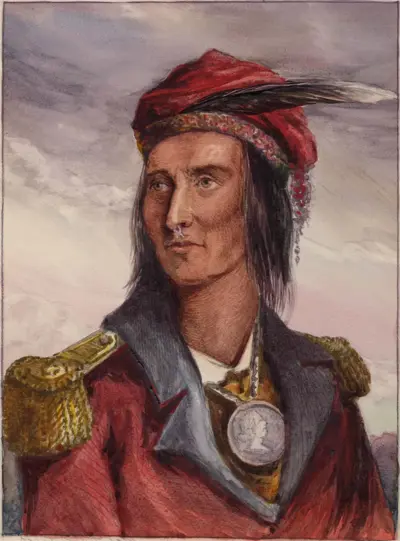
Tecumseh was a Shawnee chief and warrior who promoted resistance to the expansion of the United States onto Native American lands. A persuasive orator, Tecumseh traveled widely, forming a Native American confederacy and promoting inter-tribal unity. Although his efforts to unite Native Americans ended with his death in the War of 1812, he became an iconic folk hero in American, Indigenous, and Canadian popular history.
