Tecumseh Quotes
Brothers — My people wish for peace; the red men all wish for peace; but where the white people are, there is no peace for them, except it be on the bosom of our mother. Where today are the Pequot? Where are the Narragansett, the Mohican, the Pokanoket, and many other once powerful tribes of our people? They have vanished before the avarice and the oppression of the White Man, as snow before a summer sun. Will we let ourselves be destroyed in our turn without a struggle, give up our homes, our country bequeathed to us by the Great Spirit, the graves of our dead and everything that is dear to us? I know you will cry with me, Never! NEVER!.
Tecumseh, 1768-1813, Shawnee Indian leader, Speech before a joint council of the Choctaw and Chickasaw nations, 1811
Sourced by: Eigen's Political and Historical Quotations


American Indians not only had no culture of alcohol and drinking in moderation, but most Native Americans have a genetic susceptibility to alcoholism.

It was the beginning of the Zulu War.


Many American leaders wanted to comply with and enforce the Indian treaties, but the remoteness made it difficult. There were always those whites who did not want to be restricted by Indian treaties who took advantage of the situation when there was a leader like Clinton who wanted to enforce the treaties. However in many cases, the American leadership really did not want to enforce the treaties and in some cases, as with President Andrew Jackson, wanted to abrogate the treaties with the Indians.

In 1877 Gen. O. O. Howard and 600 men fought Chief Joseph and his Nez Perce warriors near Kamiah, Idaho. Outnumbered and outflanked, Chief Joseph headed his band toward the Canadian border, but before they reached it they were captured. Chief Joseph's surrender speech was recorded by General Howard's adjutant: Thunder Rolling Down the Mountain


This was passed in 1787 before the Constitution had become operative, but was then ratified by Congress in 1789. It was one of the first acts of our new nation, and one of the most frequently violated throughout our history.

First Published American Indian Author


In March of 1814 Jackson led a force to track down the Red Sticks. When they did so at Horseshoe Bend. Jackson made a frontal assault on the Red Stick Breastworks which might have gone badly had not a cotangent of Cherokee Indians—also concerned about the Red Sticks attack on their settlements, assaulted the Red Sticks from the rear. The Red Sticks, caught between the two uncoordinated attackers, lost over 900 men and the battle which then decided the war. In this Battle, Junaluska, a Cherokee, saved Jackson’s life. Years later he would not differentiate between the different Indian peoples and contrary to a Supreme Court order, forced the Cherokee from their settled farms and ranches and moved them to the Oklahoma Territory.


The Prime Minister, Neville Chamberlain, preceded him with the announcement of declaration of war against Germany, but it was left up to the Foreign Minister to explain the implications. This was the first time in history that a nation had used radio to communicate such momentous events to its population.


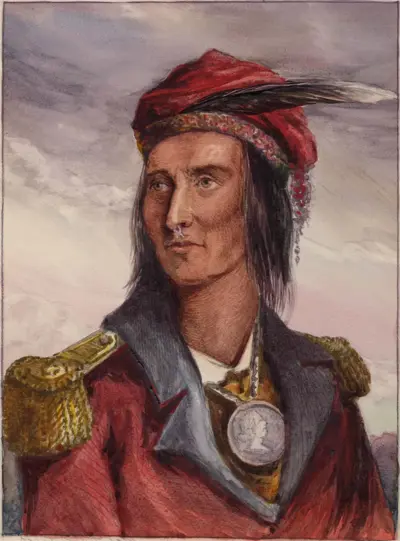
Tecumseh was a Shawnee chief and warrior who promoted resistance to the expansion of the United States onto Native American lands. A persuasive orator, Tecumseh traveled widely, forming a Native American confederacy and promoting inter-tribal unity. Although his efforts to unite Native Americans ended with his death in the War of 1812, he became an iconic folk hero in American, Indigenous, and Canadian popular history.
