Andrew Jackson Quotes
Is a citizen of the United States to remain under the barbarous lash of cruel and unrelenting savages?
In March of 1814 Jackson led a force to track down the Red Sticks. When they did so at Horseshoe Bend. Jackson made a frontal assault on the Red Stick Breastworks which might have gone badly had not a cotangent of Cherokee Indians—also concerned about the Red Sticks attack on their settlements, assaulted the Red Sticks from the rear. The Red Sticks, caught between the two uncoordinated attackers, lost over 900 men and the battle which then decided the war. In this Battle, Junaluska, a Cherokee, saved Jackson’s life. Years later he would not differentiate between the different Indian peoples and contrary to a Supreme Court order, forced the Cherokee from their settled farms and ranches and moved them to the Oklahoma Territory.
Andrew Jackson, 1767-1845, 7th President of the United States (Democrat, TN) Question he posed when news reached him in Nashville that the Red Stick Indians were attacking settlers, 1814
Sourced by: Eigen's Political and Historical Quotations


This comprehensive report of 457 pages was written, printed and distributed at her expense prior to her Federal appointment.


At the time, some Palestinian Arabs claimed exclusive rights to the territory on the grounds that Arabs had dominated the area for the longest period of time. They gave no credence to the fact that the Jews had dominated the area and it was the center of their kingdom for many years before—that Jews had constantly lived in the area of longer than the Arabs, nor did they give any credence to the fact that the Christians had conquered the area from the Muslims during the Crusades.

Published 100 years after it was written. This is the first known written statement of what became a de facto policy regarding the American Indian.


Wayne played so many parts depicting whites in the process of expanding Westward that many people saw him as an expert on the history of the Westward Expansion. He did not comment on the whites who then kept huge ranches “selfishly” for themselves or those who selfishly would not share the mineral rich land that they had taken with anyone including the original Indian owners. So in this view, the Indians should have not been capitalists but they should have been socialists and shared their resources.

See {633119} for the basic provision of the Dawes Act.

At the time, Jefferson was the Governor of Virginia and the Indians and white settlers in the Western part of the state were coming into increasing conflict. This rather heartless and blood thirsty quotation of Jefferson’s surprises many of his great admirers. Especially because of his historical sophisticated and empathetic way he treated Indians. See {589102}, {589103}, {589113}, {589125}, and {605068}. Jefferson saw Indians much like he saw whites—differentially. Some were friends, some neutral, and some dangerous enemies. His wish to exterminate or ethnically cleanse these Indians was limited to these Indians—not to Indians in general. Nonetheless, it shows a violent side of Jefferson that was in play with enemies. As President, he was aggressive against the Muslim Pirates (see {623707} and {617123}).

What is interesting is that when he cites the dreadful facts about American slavery, he never points out that the American slave traders rarely raided the villages and captured the slaves themselves. Most often this was done my Khamenei’s Muslim brethren slave traders who dominated the slave trade in Africa. Nor does he point out what after realizing the evil that Americans perpetrated with slavery, we ended it in the 1860s. Saudi Arabia, the central nation of Islam, did not make slavery illegal until 100 years later, and even today, there are many Saudi’s who get caught practicing slavery with household servants and forms of indentured servitude. And while Christians and the Bible tolerated slavery, the Koran and the Prophet never once condemn the practice of slavery. Democracy at any point in time is not always morally right, but it is a process by which under pressure from the people it improves over time because the people can change it and do.


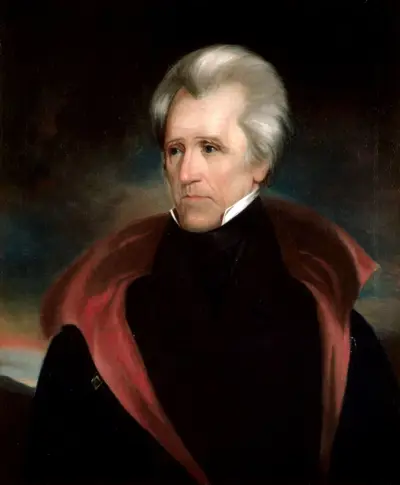
Andrew Jackson was an American lawyer, soldier, and statesman who served as the seventh president of the United States from 1829 to 1837. Before being elected to the presidency, Jackson gained fame as a general in the United States Army and served in both houses of the U.S. Congress. An expansionist president, Jackson sought to advance the rights of the "common man" against a "corrupt aristocracy" and to preserve the Union.
