Standing Bear Quotes
The pressure that has been brought to bear upon the native people, since the cessation of armed conflict, in the attempt to force conformity of custom and habit has caused a reaction more destructive than war, and the injury has not only affected the Indian, but has extended to the white population as well.
Standing Bear, 1868-1937, Oglala Sioux Indian Chief, Land of the Spotted Eagle
Sourced by: Eigen's Political and Historical Quotations

Samuel Langhorne Clemens, 1835-1910. Twain was one of the few whites who realized that success in assimilating American Indians would destroy their culture and identity. Even today, whites and Indians alike constantly debate the desirability of assimilation policies and supporting independent reservations.

“Cleaned out” meant destroyed. He had been a strong advocate of peace with whites. See {610679} .

First Published American Indian Author


Miller was the first Black American admitted to a Graduate Program—Johns Hopkins—in Mathematics

Shabonee in a warning ride reminiscent of Paul Revere, warned many white settlers of an impending attack by unfriendly Indians. He also gave an eyewitness account of the Battle of Tippecanoe which propelled Harrison to the Presidency. The U. S. Navy named a ship in his honor in the 1940s. Several schools are named for him also.

Clinton was a founder of the society. Many sophisticated Americans were in despair about the consequence of White contact with the Indian, and this was even before the worst of the treatment which came later, beginning under the presidency of Andrew Jackson and continuing well into the 20th century. Of particular interest is Clinton’s prescient observations regarding Africa and Africans interacting with whites with slavery the overriding white motive. Clinton was one of the many Americans who were abolitionists from the beginning of the nation.

Carson was one of the few Indian Agents who spent every penny of his budget on the Indians as opposed to himself. He was married to an Indian woman and was close enough to many Indians that he understood their resentment whenever they came into a town. They were treated terribly and while most of them were literally starving, seeing the white opulence produced resentment.

This has been a classic dilemma for all large multi ethnic states—trying to develop a sense of unity of citizenship in the face of populations who think of themselves foremost differently. Attempts like this of banning the names of the peoples from official use, banning languages, changing people’s names, requiring common dress and other such methods have failed in most cases (Ataturk’s Turkey being the notable exception). America, Great Britain and the Soviet Union showed the world that it was possible to have a strong sense of national unity and at the same time allow peoples, cultures, and ethnicities to maintain their own ethnic identities. However, many modern governments see their situation as so unique that ethnic repression of one kind or another is required. Modern China, in particular, while not as extreme as Sun Yat-Sen still makes it very difficult for certain cultures to thrive such as the Tibetans. Note that even in the United States we have many who argue that non English language usage should be discouraged and disapprove of the concept of hyphenated Americans. For example, see Theodore Roosevelt {631377}.
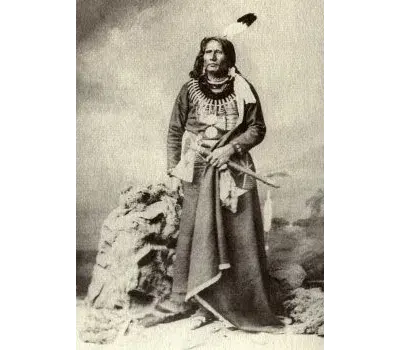
Standing Bear (c. 1829–1908) (Ponca official orthography: Maⁿchú-Naⁿzhíⁿ/Macunajin; other spellings: Ma-chú-nu-zhe, Ma-chú-na-zhe or Mantcunanjin pronounced [mãtʃuꜜnãʒĩꜜ]) was a Ponca chief and Native American civil rights leader who successfully argued in U.S. District Court in 1879 in Omaha that Native Americans are "persons within the meaning of the law" and have the right of habeas corpus, thus becoming the first Native American judicially granted civil rights under American law. His first wife Zazette Primeau (Primo), daughter of Lone Chief (also known as Antoine Primeau), mother of Prairie Flower and Bear Shield, was also a signatory on the 1879 writ that initiated the famous court case.
