William Apess Quotes
Sober-thoughted men, far from the scenes of danger, in the security of cities and populous regions, can talk of exterminating measures, and discuss the policy of extirpating thousands… in a little while, the remaining tribes will go the way that so many have gone before. They will vanish like a vapor from the face of the earth – their very history will be lost in forgetfulness.
William Apess, 1798-1839 Pequot Indian author, Methodist minister, and political activist 1829
Sourced by: Eigen's Political and Historical Quotations

This quotation is often used as the greatest evidence the white usurpation of Indian land and the dubious value of all the treaties that had been made with the Indians guaranteeing them specific lands. Jackson, however, was not completely accurate. The Iroquois who fought on the American side in the Revolution were still on their lands in New York State. However, the Iriquois had their dealings with the State and local governments, and fared better than those tribes that depended in the Federal Government—especially with racists like Jackson in the Presidency.

First Published American Indian Author


Clinton was a founder of the society. Many sophisticated Americans were in despair about the consequence of White contact with the Indian, and this was even before the worst of the treatment which came later, beginning under the presidency of Andrew Jackson and continuing well into the 20th century. Of particular interest is Clinton’s prescient observations regarding Africa and Africans interacting with whites with slavery the overriding white motive. Clinton was one of the many Americans who were abolitionists from the beginning of the nation.

At the time, Jefferson was the Governor of Virginia and the Indians and white settlers in the Western part of the state were coming into increasing conflict. This rather heartless and blood thirsty quotation of Jefferson’s surprises many of his great admirers. Especially because of his historical sophisticated and empathetic way he treated Indians. See {589102}, {589103}, {589113}, {589125}, and {605068}. Jefferson saw Indians much like he saw whites—differentially. Some were friends, some neutral, and some dangerous enemies. His wish to exterminate or ethnically cleanse these Indians was limited to these Indians—not to Indians in general. Nonetheless, it shows a violent side of Jefferson that was in play with enemies. As President, he was aggressive against the Muslim Pirates (see {623707} and {617123}).


The report was on the Turkish brutality in Post WW I Smyrna against the Greek population. Several hundred thousand Greeks were killed. This was after the Armenian Genocide during WWI. The irony was that America, England and France all agreed that Turkey should administer the Turkish port city of Smyrna on the Aegean coast of Anatolia which was inhabited by a substantial Greek Orthodox Christian population in Muslim Turkey. In addition to the problem of a religious minority, the Turks had then, and many still have today, a desire for revenge against the Greeks. Greece had been a province of the Turkish Ottoman Empire for centuries until the Greek revolt of 1821. Ethnic Greeks living in Turkey, with an equally paranoidal preoccupation in history did not make very good citizens of Turkey.


Samuel Langhorne Clemens, 1835-1910. Twain was one of the few whites who realized that success in assimilating American Indians would destroy their culture and identity. Even today, whites and Indians alike constantly debate the desirability of assimilation policies and supporting independent reservations.

His troops exterminated 90% of the Herero people. In addition, German Doctors did hideous experiments on the Herero. WWII German mass murders had German precedents.


Over the years Sherman’s advocacy of Indian extermination went beyond the Sioux to all Indians.

One of the most murderous struggles in history was when Turkey was fighting Armenia. The peoples had, and still do have, a great hatred towards each other. The Turks had a large ethnic Armenian population and the Turkish government decided to “relocate” them. In the process many Armenians were brutally murdered, The Armenians however also butchered Turks whenever they could. The events were so brutal, that neither Turkey or Armenia teach about their own atrocities in their schools, but tell their students of the other’s atrocities. Historial denial governs this conflict and its war crimes.


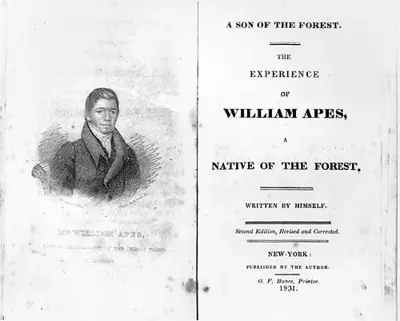
William Apess (1798–1839, Pequot) (also known as William Apes before 1837), was an ordained Methodist minister, writer, and activist of mixed-race descent, who was a political and religious leader in Massachusetts. After becoming ordained as a Methodist minister in 1829, he published his autobiography the same year. It is among the first autobiographies by a Native American writer. Apess was part Pequot by descent, especially through his mother's family, and identified with their culture.
