DeWitt Clinton Quotes
The causes of their [Indians’] degradation and diminution, are principally to be found in their baneful communication with the man of Europe, which has contaminated their morals, destroyed their population, robbed them of their country, and deprived them of their national spirit. Indeed, when we consider, that the discovery and settlement of America, have exterminated millions of the red men, and entailed upon the sable inhabitants of Africa, endless and destructive wars, captivity, slavery and death, we have reason to shudder at the gloomy perspective
Clinton was a founder of the society. Many sophisticated Americans were in despair about the consequence of White contact with the Indian, and this was even before the worst of the treatment which came later, beginning under the presidency of Andrew Jackson and continuing well into the 20th century. Of particular interest is Clinton’s prescient observations regarding Africa and Africans interacting with whites with slavery the overriding white motive. Clinton was one of the many Americans who were abolitionists from the beginning of the nation.
DeWitt Clinton, 1769-1828, Vice President of the United States (NY), U. S. Senator (Anti-Federalist Republican, NY), Mayor of New York City, Governor of New York, Peace Party candidate for President of the United States, “Father of Free Public Schools", Speech to the New York Historical Society, December 6, 1811
Sourced by: Eigen's Political and Historical Quotations

Even at this early time, it was clear that whites had brought numerous diseases that decimated the Indians. Alcohol and disease killed many more native Americans than all the wars—intertribal and with the whites—ever did. Neolin warned but did not have more than regional influence.
First Published American Indian Author


Clark’s men had English Colonel Hamilton under siege by making him think there were many more Americans in Clarks army than the real 180 or so. He tried to get Hamilton to surrender by threatening if they had to take the fort they would treat Hamilton and the British as murderers—Hamilton had paid hostile Indians for American scalps. At that point a party of Clark’s men arrived with 4 or 5 Indian prisoners who had been captured raiding
civilian farms. After the Indians were executed, Hamilton agreed to surrender.


The economic development contribution of military spending is not new and not limited to today’s military bases and defense contracts and plants. See {623902} for Sheridan’s famous prediction.

Some Mexicans have always resented the U. S. for “colonizing” Arizona and other territory that once belonged to Mexico. This quotation is very revealing concerning the reality on the ground. The Apache were on the land when the Mexicans moved in to “civilize” the territory. However, the Apache, by violence, drove the Mexicans out. At that point the Mexicans were happy to sell Arizona to the Americans and the Gadsden Purchase brought Arizona to the United States as a territory. The Americans however didn’t buy the land from the Apache, the owners before the Mexicans claimed it. Many Apaches continued the violence against whoever tried to settle in the area. Eventually, the Americans accomplished what the Mexicans did not—militarily subduing the Apache.

Samuel Langhorne Clemens, 1835-1910. Twain was one of the few whites who realized that success in assimilating American Indians would destroy their culture and identity. Even today, whites and Indians alike constantly debate the desirability of assimilation policies and supporting independent reservations.

John Mason led a force of 90 Pilgrims and 70 Mohegan Allies quietly surrounded the Pequot village at Mystic. Then they fired their guns into the village and charged the Pequot houses, setting them on fire and killing all those who tried to escape. Over 400 Pequot were killed. The Mohegan allies were so shocked at the carnage that they shouted, “Stop! Stop! It is naught, it is naught, because it is too furious, and slays too many men.” Prior to the massacre of Mystic Village, there had been many battles and villages destroyed, but this marked the first time that entire populations of men, women and children were exterminated in the English Colonization. After Mystic village both whites and Indians participated in terrible massacres inflicted on each other. This was not the first massacre in America as the Spanish in the South and West commonly used the tactic.
American Indians not only had no culture of alcohol and drinking in moderation, but most Native Americans have a genetic susceptibility to alcoholism.

At the time, Jefferson was the Governor of Virginia and the Indians and white settlers in the Western part of the state were coming into increasing conflict. This rather heartless and blood thirsty quotation of Jefferson’s surprises many of his great admirers. Especially because of his historical sophisticated and empathetic way he treated Indians. See {589102}, {589103}, {589113}, {589125}, and {605068}. Jefferson saw Indians much like he saw whites—differentially. Some were friends, some neutral, and some dangerous enemies. His wish to exterminate or ethnically cleanse these Indians was limited to these Indians—not to Indians in general. Nonetheless, it shows a violent side of Jefferson that was in play with enemies. As President, he was aggressive against the Muslim Pirates (see {623707} and {617123}).
Many American leaders wanted to comply with and enforce the Indian treaties, but the remoteness made it difficult. There were always those whites who did not want to be restricted by Indian treaties who took advantage of the situation when there was a leader like Clinton who wanted to enforce the treaties. However in many cases, the American leadership really did not want to enforce the treaties and in some cases, as with President Andrew Jackson, wanted to abrogate the treaties with the Indians.


First Indian to hold the position
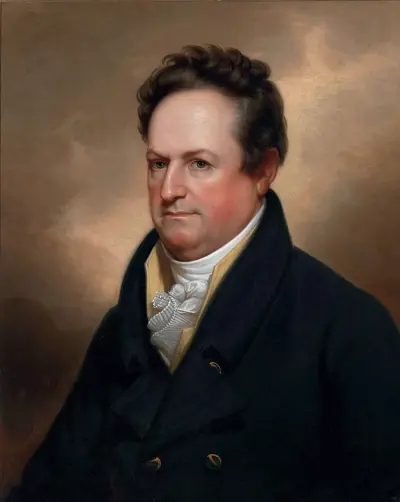
DeWitt Clinton, whose name was almost always spelled De Witt during his lifetime and until the late 20th century, was an American politician and naturalist. He served as a United States Senator, Mayor of New York City, and as the sixth Governor of New York. In this last capacity, he was largely responsible for the construction of the Erie Canal. Clinton was a major candidate for the American presidency in the election of 1812, challenging incumbent James Madison.
