George Catlin Quotes
I have, for many years past, contemplated the noble races of red men who are now spread over these trackless forests and boundless prairies, melting away at the approach of civilization. Their rights invaded, their morals corrupted, their lands wrested from them, their customs changed, and therefore lost to the world; and they at last sunk into the earth, and the ploughshare turning the sod over their graves, and I have flown to their rescue--not of their lives or of their race (for they are "doomed" and must perish), but to the rescue of their looks and their modes, at which the acquisitive world may hurl their poison and every besom of destruction, and trample them down and crush them to death
George Catlin, 1796-1872, Artist, Letters And Notes On The Manners, Customs, And Conditions Of North American Indians, 1844
Sourced by: Eigen's Political and Historical Quotations


First Published American Indian Author


This quotation is often used as the greatest evidence the white usurpation of Indian land and the dubious value of all the treaties that had been made with the Indians guaranteeing them specific lands. Jackson, however, was not completely accurate. The Iroquois who fought on the American side in the Revolution were still on their lands in New York State. However, the Iriquois had their dealings with the State and local governments, and fared better than those tribes that depended in the Federal Government—especially with racists like Jackson in the Presidency.
Even at this early time, it was clear that whites had brought numerous diseases that decimated the Indians. Alcohol and disease killed many more native Americans than all the wars—intertribal and with the whites—ever did. Neolin warned but did not have more than regional influence.

The central Indian policy problem for Jefferson’s Administration was the fact that most Indians hunted for subsistence and the amount of land needed to support a hunting society was per capita much greater than an agricultural and especially an industrial one. Jefferson had no personal animosity against the Indians as many in his day did. But he perceived the need to obtain Indian lands for white agricultural use.


Gold had been discovered in the Black Hills lands that were sacred to the Lakota Sioux and were reserved for exclusive use of the Indians by the Fort Laramie Treaty. Greedy whites, ignoring the treaty provisions not only entered the Black Hills to pan and mine for the gold, but killed many Indians they ran across Sherman was angry and wrote to his old friend President Grant. Grant, now a political, had to contend with public opinion that thought it absurd that gold should not be mined because a few Indians regarded the land as sacred. Meanwhile Grant was working with a few others to portray minor clashes between whites and Indians in the Black Hills as violent and dangerous Indians breaking the treaty.


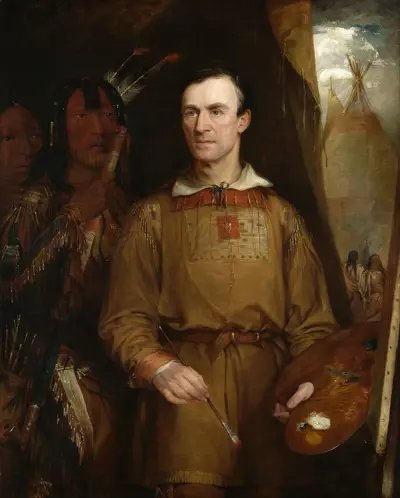
George Catlin was an American lawyer, painter, author, and traveler, who specialized in portraits of Native Americans in the Old West.
