Timothy Pickering Quotes
The United States will pay the sum of five thousand dollars, to be distributed among individuals of the Oneida and Tuscorora nations, as a compensation for their individual losses and services during the late war between Great-Britain and the United States.
The rationale for paying these Indians was given in the beginning of the treaty. See {612283}. In addition the treaty provided for the Federal government to build a flour mill and a saw mill and provide technical staff to operate and maintain them. In an interesting gesture the Federal government rebuilt a church that had been the house of worship for some Oneida Presbyterians. The English and the other Iroquois had burned the church to the ground. See {621968}. This is one of the few times in history, and certainly the first time, that the Federal government constructed a church for a particular sect. The other tribes of the Iroquois nation had allied themselves with the English. See {583726}. Only the Oneida joined the colonist cause. At the end of the war, the other Iroquois tribes were run out of the country and they escaped to Canada. The Oneida, in contrast, were rewarded by the Federal government and integrated into New York State society.
Timothy Pickering, 1745-1829, U. S. Congressman & Senator (Federalist, MA), Postmaster General, Secretary of War, Secretary of State, Treaty between the United States and the Oneida, Tuscorora and Stockbridge Indians, 1794
Sourced by: Eigen's Political and Historical Quotations

The purpose was to persuade the Iroquois Indians to stay neutral in the coming conflict with England. Iroquois had traditionally traded peaceably & on many occasions the colonists & Iroquois had fought against the French and other Indians. The colonists appealed to their strong sense of fairness--{610960}. A Mohawk chief, Joseph Brant, had traveled to England and been educated there. He persuaded 5 of the Iroquois tribes to join the obvious winner—England. Only the Oneida joined the revolutionists. The result was a civil, fratricidal war of not only white, but also of Iroquois who had been at peace with each other since any could remember. When the colonists won, the Oneida were warmly embraced and participated in colonial life and activities. (A little over 200 years later the average earnings of the Indian in New York State exceeded that of the average white.) The other 5 Iroquois tribes however were driven from their traditional lands. They fled with Joseph Brant to English Canada.

See {612285} also for the specific payments to the Indians. The other tribes of the Iroquois nation had allied themselves with the English. See {583726}. Only the Oneida joined the colonist cause. At the end of the war, the other Iroquois tribes were run out of the country and they escaped to Canada. The Oneida, in contrast, were rewarded by the Federal government and integrated into New York State society.

Brant had an English style Missionary education and was an Anglican, belonging to the Church of England. During the American Revolution, he persuaded most of the Iroquois tribes to fight for the British against the revolutionary colonists. However, the Oneida tribe was not persuaded and joined the rebel side. A few New England Presbyterian missionaries had targeted the Oneida people, and when that tribe chose the “wrong” side, Brant believed that the reason was their different religious point of view. After the Revolution, Brant and his Iroquois followers were driven out of their American lands and escaped to Canada, while the Oneida were given complete title to their lands by George Washington.


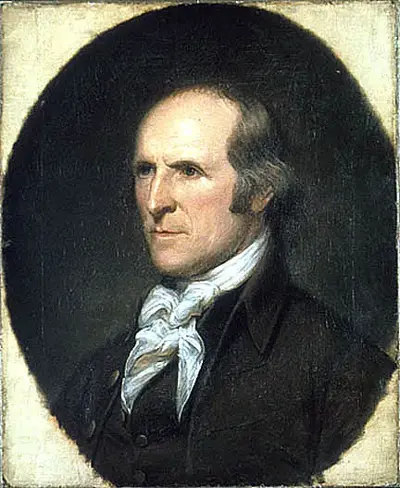
Timothy Pickering was a politician from Massachusetts who served in a variety of roles, most notably as the third United States Secretary of State under Presidents George Washington and John Adams. He also represented Massachusetts in both houses of Congress as a member of the Federalist Party. In 1795, he was elected a member of the American Philosophical Society.
