John Burgoyne Quotes
A country unpeopled and most unknown in the last war [French & Indian War] … it now abounds in the most active and most rebellious race of the continent, and hangs like a gathering storm on my left.
John Burgoyne, 1722-1792, British General, Commander of British Troops in the American Revolution, Description of New Hampshire at the beginning of the American Revolution, Letter to Lord George Germain
Sourced by: Eigen's Political and Historical Quotations

The rationale for paying these Indians was given in the beginning of the treaty. See {612283}. In addition the treaty provided for the Federal government to build a flour mill and a saw mill and provide technical staff to operate and maintain them. In an interesting gesture the Federal government rebuilt a church that had been the house of worship for some Oneida Presbyterians. The English and the other Iroquois had burned the church to the ground. See {621968}. This is one of the few times in history, and certainly the first time, that the Federal government constructed a church for a particular sect. The other tribes of the Iroquois nation had allied themselves with the English. See {583726}. Only the Oneida joined the colonist cause. At the end of the war, the other Iroquois tribes were run out of the country and they escaped to Canada. The Oneida, in contrast, were rewarded by the Federal government and integrated into New York State society.

While the official battles of the American Revolution did not begin until 1776, parts of the American colonies were in a de facto state of rebellion and the British could not enforce their laws. See {636925} for another of the King’s statements.

Wilkes was a strong advocate for the American cause—so much so that some in Parliament tried to deny him his seat in Parliament for his disloyal point of view.

This letter drafted by Adams was sent by the Congress complaining about the Closing of Boston Harbor. The letter was right about the consequences except for the last; the rift between American and the mother country was not only healed but there is no European nation that has been closer to the United States over the years.

Clinton was a founder of the society.

He was acting as French Foreign Secretary at the time.

The crackdown on Boston which was intended to set an example and intimidate all of the other colonies backfired, and the British were told about it by their own officials in America. But they were so rigid and ideological about monarchy, that the stimulated rebellion rather than suppress them.

Of the 13 colonies, the 3 Middle Atlantic States, were the least enthusiastic about an armed revolution against England. Jersey—Now New Jersey—was the most recalcitrant then with Benjamin Franklin’s son as Governor. See {634108} for an explanation of why that was.

This was written more than a year before the “blows” began. It took time to ship the men and supplies to America and the British did not handle that task with much efficiency.

Fox was one of the opposition leaders who were opposed to the heavy handed policies that the British King and Government had used.


His idea was to send English people who were vagabonds, paupers, failures, and never do wells to America. These people in England were just “waste”. But in America, the could be apprenticed or become indentured servants, learn skill and they would (and indeed did) become the corps of laborers needed to cut down the trees, beat the hemp (for making rope), gather honey, salt and dry fish, dress raw animal hides, dig the earth for minerals, raise olives and silk, and sort and pack bird feathers. In England they were so desperate that they would work in the difficult conditions of the colonies and would be willing to venture out from the country and culture in which they existed—a major problem in getting colonial workers.

Howe had written Franklin attempting to stave off a American break with England. Franklin, with the approval of the Continental Congress, replied.


2nd Earl of Guilford. This bill cut off all trade with the American Colonies. It was meant as pressure to cease the rebellion. It did not work.
The simplistic view that the American colonists were patriots and the British were the colonizers against whom the colonists revolted is not really accurate. The American colonists were polarized into patriots and loyalists. The Loyalist Americans ranged from many of those merchants whose business depended upon England, those whose family were still in England, those whose religion made them loyal to the Church of England, slaves who would be free under British law, Americans who had strong cultural and intellectual ties to England and those Americans who were great believers in monarchy and whose honor required that they fulfill the oath that they had taken to the King of England. Some of the worst atrocities of the American Revolution occurred in the battles of these Americans against each other. See {82105} for more on this point.
Note that Britain was blockading Boston in the middle of 1775, some time before the outbreak of battles in Concord and Lexington in 1776. What Gates did not tell Lord Dartmouth, and maybe did not know himself, was that the skilled Massachusetts sailors smuggled a great deal through the blockade in small boats at night landing in the many inlets and coves in the Boston area. Also, do not think of Boston in 1775 as today. At that time most people had, in the city, their own farms and gardens and grew much of their own food. The Boston Commons was a common area for grazing sheep. So the British Blockade of Boston was not very effective.
The American plan was to capture Quebec and add that province to the 13 colonies. See {636940} . However, the American officers botched the invasion and did not attack as soon as they arrived when the British had almost no troops to defend Quebec.


Earlier, his father had also castigated the ministers over their inept hard-line handling of the American Revolution. See {641505} .

This is a very interesting quotation. A contemporary historian tells us how rapidly the American colonists organized when Parliament passed the Tea Tax. Even with the Internet and social media it would be hard to organize representation from 13 states that fast today. The word of mouth and mail of the day was surprising to most of us. The passion on the issue and the public interest must have been extraordinary. Ramsay was the first major historian of the American Revolution.
during and after the American Revolution
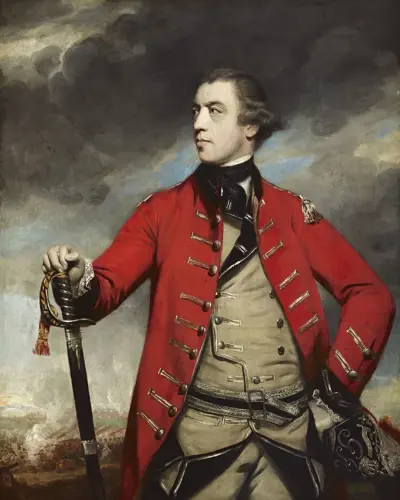
General John Burgoyne was a British army officer, dramatist and politician who sat in the House of Commons from 1761 to 1792. He first saw action during the Seven Years' War when he participated in several battles, most notably during the Portugal Campaign of 1762.
