Samuel Adams Quotes
We would express to your Excellency the just Resentment which we feel at the Indignities offered to our worthy fellow Citizens in Boston and the frequent Violations of private property by the Soldiers under your Command. These Enormities committed by a Standing Army, in our opinion, unlawfully posted there in a time of Peace, are irritating in the greatest Degree, and if not remedied will endanger the involving all America in the Horrors of a civil War! Your Situation Sir is extremely critical. A rupture between the Inhabitants of the Province over which you preside and the Troops under your Command would produce Consequences of the most serious Nature: A Wound which would never be healed! It would probably establish Animosities between Great Britain & the Colonies which time would never eradicate!
This letter drafted by Adams was sent by the Congress complaining about the Closing of Boston Harbor. The letter was right about the consequences except for the last; the rift between American and the mother country was not only healed but there is no European nation that has been closer to the United States over the years.
Samuel Adams, 1722-1803, Governor of Massachusetts, Member of the Continental Congress, Letter from the Continental Congress to General Thomas Gage, the British Governor, October 8, 1774
Sourced by: Eigen's Political and Historical Quotations


The fear of civil war amongst the colonies if they were free from Britain was substantial.


This quotation shows that the dissent leading to the American Revolution did not emerge suddenly in 1776 after the Battle of Bunker Hill. Dissent, sedition and even violence was documented here in 1774. Salem at the time was the second largest port in the colony and the customs tax collectors—Loyalist Americans—were run out of Salem.

This is the same man who introduced the Stamp Act 12 years before which started the whole problem in America. See {74956}.
The fear of civil war amongst the colonies if they were free from Britain was substantial. There were a number of potential conflict flash points of which slavery was one. See {619100}


Americans were by no means united in wanting to take up arms against Britain. Relatively few of the loyalist quotations have come down to us, but here is one. It also illustrates why some Americans wanted complete independence: So that they could escape their debts to English merchants. Most however had more noble and unselfish motives. As a matter of fact, the American Revolution is unusual in the sense that there were so many men of substance who sacrificed much of their material wealth for the American ideal. There were also the rogues and opportunists as Galloway describes.

Several years before the Battle of Bunker Hill, revolutionary activity had already broken out in the American colonies—See {634132} for an example. This law gave the British authorities much more “clout” in dealing with the “seditious” American activities. It protected English law enforcement officials from being tried in local Colonial courts for murder or assault in putting down insurrections. George Washington and other Patriots were outraged over this law. See {634131}.

The simplistic view that the American colonists were patriots and the British were the colonizers against whom the colonists revolted is not really accurate. The American colonists were polarized into patriots and loyalists. The Loyalist Americans ranged from many of those merchants whose business depended upon England, those whose family were still in England, those whose religion made them loyal to the Church of England, slaves who would be free under British law, Americans who had strong cultural and intellectual ties to England and those Americans who were great believers in monarchy and whose honor required that they fulfill the oath that they had taken to the King of England. Some of the worst atrocities of the American Revolution occurred in the battles of these Americans against each other. See {82105} for more on this point.

This was written more than a year before the “blows” began. It took time to ship the men and supplies to America and the British did not handle that task with much efficiency.
This was written more than a year before the American Revolution Battles began. It took time to ship the men and supplies to America and the British did not handle that task with much efficiency. See {636926} for another of the King’s statements.

See {641497} for a quote from the Grenville speech. Fox, a conservative on most issues was an absolute radical on the issue of America. To aggravate the hawks in parliament, he used to dress in the colors of George Washington’s uniform to show his support once the war broke out.

Earlier, his father had also castigated the ministers over their inept hard-line handling of the American Revolution. See {641505} .

Mackenzie was a British officer with whom Washington had become friends in the French & Indian War and in this letter, Washington was trying to explain the seriousness of the Boston rebellion for Britain.


England had gone through a bloody Civil War with the Parliament on one side and the King on the other. The King lost and was beheaded later that year. See {597353}.
The Parliament was debating the reaction to the Stamp Act by the American Colonies. One of the members, reflecting a majority view, asked sarcastically when the American Colonies had been emancipated so that they could make their own independent decisions. Pitt then hit this one out of the park by reversing the question.

This resolution was the trigger that began the debate which became the Declaration of Independence.

Most Canadians supported the English despite the letter.
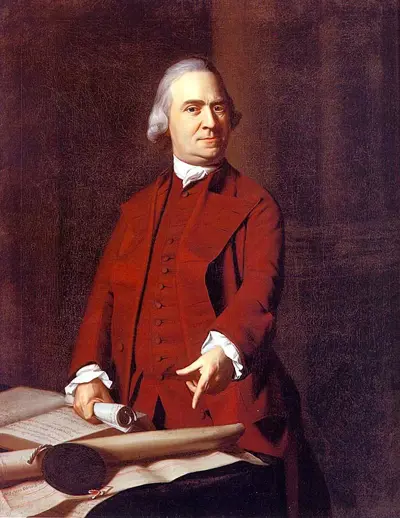
Samuel Adams was an American statesman, political philosopher, and one of the Founding Fathers of the United States. He was a politician in colonial Massachusetts, a leader of the movement that became the American Revolution, and one of the architects of the principles of American republicanism that shaped the political culture of the United States. He was a second cousin to his fellow Founding Father, President John Adams.
