John Witherspoon Quotes
If the colonies are independent states, separate and disunited, after this war, we may be sure of coming off by the worse. We are in no condition to contend with several of them. Our trade in general, and our trade with them, must be upon such terms as they shall be pleased to prescribe. What will be the consequence of this? Will they not be ready to prefer putting themselves under the protection of Great Britain, France, or Holland, rather than submit to the tyranny of their neighbors, who were lately their equals? Nor would it be at all impossible that they should enter into such rash engagements as would prove their own destruction from a mixture of apprehended necessity and real resentment.
The fear of civil war amongst the colonies if they were free from Britain was substantial.
John Witherspoon, 1723-1794, Presbyterian minister, President of Princeton University, Member of the Continental Congress (NJ) & Signer of the Declaration of Independence, Debate in the Continental Congress
Sourced by: Eigen's Political and Historical Quotations

The fear of civil war amongst the colonies if they were free from Britain was substantial. There were a number of potential conflict flash points of which slavery was one. See {619100}

This is the same man who introduced the Stamp Act 12 years before which started the whole problem in America. See {74956}.

Franklin was also an accomplished political cartoonist.

See {641497} for a quote from the Grenville speech. Fox, a conservative on most issues was an absolute radical on the issue of America. To aggravate the hawks in parliament, he used to dress in the colors of George Washington’s uniform to show his support once the war broke out.


This letter drafted by Adams was sent by the Congress complaining about the Closing of Boston Harbor. The letter was right about the consequences except for the last; the rift between American and the mother country was not only healed but there is no European nation that has been closer to the United States over the years.

The French were carefully watching the events in the American Colonies.

2nd Earl of Guilford. This bill cut off all trade with the American Colonies. It was meant as pressure to cease the rebellion. It did not work.


Americans were by no means united in wanting to take up arms against Britain. Relatively few of the loyalist quotations have come down to us, but here is one. It also illustrates why some Americans wanted complete independence: So that they could escape their debts to English merchants. Most however had more noble and unselfish motives. As a matter of fact, the American Revolution is unusual in the sense that there were so many men of substance who sacrificed much of their material wealth for the American ideal. There were also the rogues and opportunists as Galloway describes.


This was the first official act of any state in declaring independence from England. On July 4th---almost 3 months later---Congress issued the Declaration of Independence. But North Carolina had taken the first official step.
He was acting as French Foreign Secretary at the time.


This was written more than a year before the “blows” began. It took time to ship the men and supplies to America and the British did not handle that task with much efficiency.
This was written more than a year before the American Revolution Battles began. It took time to ship the men and supplies to America and the British did not handle that task with much efficiency. See {636926} for another of the King’s statements.

While the official battles of the American Revolution did not begin until 1776, parts of the American colonies were in a de facto state of rebellion and the British could not enforce their laws. See {636925} for another of the King’s statements.
Fox was one of the opposition leaders who were opposed to the heavy handed policies that the British King and Government had used.

Earlier, his father had also castigated the ministers over their inept hard-line handling of the American Revolution. See {641505} .
Howe had written Franklin attempting to stave off a American break with England. Franklin, with the approval of the Continental Congress, replied.
This was the first proposal for a united American government. It provided for a “President-General” and a unicameral “Grand Council” with representation proportional to population.
At the beginning of the dispute between America and England, the issue was the raising of internal American taxes by Parliament without any American representation in Parliament. The issue escalated and when the British began using force, independence then became the American objective.

Hopkins was complaining about the fact that England could tax the colonies and thereby take their property without their consent made the American colonists in the “miserable condition of slaves.” Essentially the fundamental complaint of the Americans was this and in a decade it would erupt as the American Revolution. At the same time, Hopkins was a slave owner and yet saw nothing wrong with that.
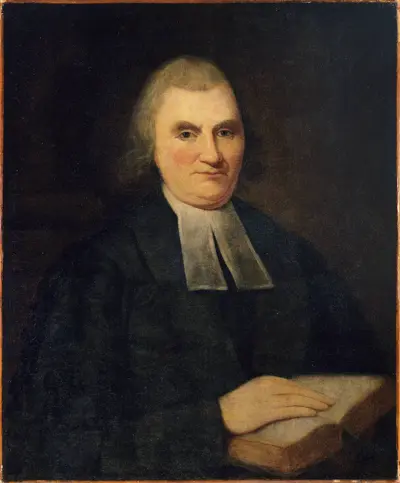
John Witherspoon was a Scottish American Presbyterian minister and a Founding Father of the United States. Witherspoon embraced the concepts of Scottish common sense realism, and while president of the College of New Jersey (1768–1794; now Princeton University), became an influential figure in the development of the United States' national character. Politically active, Witherspoon was a delegate from New Jersey to the Second Continental Congress and a signatory to the July 4, 1776, Declaration of Independence. He was the only active clergyman and the only college president to sign the Declaration. Later, he signed the Articles of Confederation and supported ratification of the Constitution. In 1789 he was convening moderator of the First General Assembly of the Presbyterian Church in the United States of America.
