William Tecumseh Sherman Quotes
I immediately sent a regiment up with orders to destroy the place, leaving [at least] one house.... The regiment has returned and Randolph is gone. It is no use tolerating such acts as firing on [civilian] steamboats. Punishment must be speedy, sure, and exemplary.... I would not do wanton mischief or destruction, but so exposed are our frail boats, that we must protect them by all the terrors by which we can surround [them].... The town was of no importance, but the example should be followed up on all similar occasions.
In addition to facing regular Confederate Troops, there were irregular insurgents who would fire at and harass normal civilian activity much like the terrorists in the Mideast today. Like today, the insurgents could exist only as long as they were sheltered and assisted by the Southern civilian population. Sherman did not see this as collective punishment as all the people in the small town of Randolph were helping the insurgents.
William Tecumseh Sherman, 1820-1891, General of the Army & Indian Peace Commissioner, Letter to John A. Rawlins, September 26: 1862
Sourced by: Eigen's Political and Historical Quotations

Some southerners had gotten out of the Confederate chain of command and were attacking civilian steamboats killing Southerners as well as “Yankees”. See {633900} . While Sherman had trouble with some of his own men on parts of his March Through Georgia, at this time, it was Southerners who were acting independently and improperly. Legally, the Confederates were responsible for any people committing terror. Sherman tried to persuade the Confederate commanders with letters like this, but was very quick to retaliate for every violation. He also complained to some Union officers that they were not moving quickly enough to retaliate and prevent future behavior--{584048}

Dagestan was the poorest of the Soviet States, It was then mainly populated by feuding Muslim sects who were in constant conflict with each other and an Islamic nationalist group that wanted independence from Russia. There were also a large number of bandits in what was a frontier culture of banditry and lawlessness.


While some of the Serbian holidays commemorate loss of battles, the idea of a specific Day of Revenge is new.
The culture of Iraq and the Desert tribes made raiding and looting of other villages or travelers or caravans a way of life. The British occupiers were determined to put an end to it and Harris, a young officer, developed the retaliation of bombing the village of the raiders and their warlords. This appears to be the beginning of destroying of houses in the Middle East as a method of retaliation and punishment which would be adopted so well by the Israelis as a humane method and they often quoted Harris saying: “we put them to the maximum amount of inconvenience, without physical hurt, and they soon stopped their raiding and looting.”


The “adversary” was Pakistan, which was frequently sending military and terrorist attacks into Kashmire much if which has been disputed by Pakistan ever since the Partition of India in 1949. India had a very disciplined and well led military and like most sophisticated military powers did not immediately retaliate for military incursions despite the public pressure to do so. Instead they gave themselves time to plan and organize the logistics for a series of surgical strikes at the terrorist and/or military concentrations Pakistan had deployed close to the border which they launched several days later.


He argues that even if the concession to terrorists is seemingly small, there is much greater damage in that the minimal concession will also stimulate more attempts to gain other victories. See {629723} for his complementary statement on dealing with terrorists.
The Minister equates the unintended consequences of war and civilian casualties with a terrorist retaliation which has as its purpose the killing of as many civilians as possible. The proliferation of terrorism complicated the ethics of counter terrorism. In the case of Palestinian terrorists their tactics included using civilian facilities---schools, hospitals, homes---from which to launch rocket attacks or to store weapons or hide terrorists. Under international laws of war, a civilian facility and the civilians in it become legitimate military targets the minute that weapons are stored in or fired from that location or that location is used for planning, training, equipping or manufacturing of military material. Palestinian terrorists claim that even though civilians were harmed in legitimate, legal attacks on military targets, a proper response is to send suicide bombers into civilian areas and preparing the explosives with nails and rat poison to cause as much pain as possible.

The Security Counsel was meeting it the Situation room at the White House

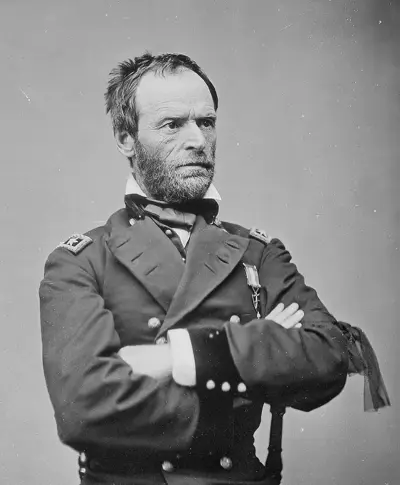
- Born: February 8, 1820
- Died: February 14, 1891
- Nationality: American
- Profession: Soldier
William Tecumseh Sherman was an American soldier, businessman, educator, and author. He served as a general in the Union Army during the American Civil War (1861–1865), receiving recognition for his command of military strategy as well as criticism for the harshness of the scorched earth policies he implemented in conducting total war against the Confederate States. British military theorist and historian B. H. Liddell Hart declared that Sherman was "the first modern general".
