William Tecumseh Sherman Quotes
If we allow the passions of our men to get full command then indeed will this war become a reproach to the names of liberty and civilization.
Some southerners had gotten out of the Confederate chain of command and were attacking civilian steamboats killing Southerners as well as “Yankees”. See {633900} . While Sherman had trouble with some of his own men on parts of his March Through Georgia, at this time, it was Southerners who were acting independently and improperly. Legally, the Confederates were responsible for any people committing terror. Sherman tried to persuade the Confederate commanders with letters like this, but was very quick to retaliate for every violation. He also complained to some Union officers that they were not moving quickly enough to retaliate and prevent future behavior--{584048}
William Tecumseh Sherman, 1820-1891, General of the Army & Indian Peace Commissioner, Letter to his Confederate counterpart Thomas Hindman in Arkansas October 17, 1862
Sourced by: Eigen's Political and Historical Quotations

Sherman was distressed at the full due process and trials that had to be given to Confederate spies and guerrillas and wanted to execute them quickly as an example. He complained to the Judge Advocate General that his men were “losing prisoners in the swamp” which both of them realized meant the immediate execution of prisoners by soldiers and junior officers which Sherman did not like either. The Lincoln administration insisted on the full due process. Even after conviction, President Abraham Lincoln tended to pardon many of the condemned.
In addition to facing regular Confederate Troops, there were irregular insurgents who would fire at and harass normal civilian activity much like the terrorists in the Mideast today. Like today, the insurgents could exist only as long as they were sheltered and assisted by the Southern civilian population. Sherman did not see this as collective punishment as all the people in the small town of Randolph were helping the insurgents.


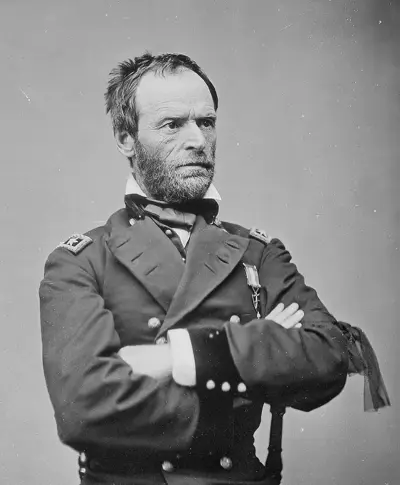
William Tecumseh Sherman was an American soldier, businessman, educator, and author. He served as a general in the Union Army during the American Civil War (1861–1865), receiving recognition for his command of military strategy as well as criticism for the harshness of the scorched earth policies he implemented in conducting total war against the Confederate States. British military theorist and historian B. H. Liddell Hart declared that Sherman was "the first modern general".
