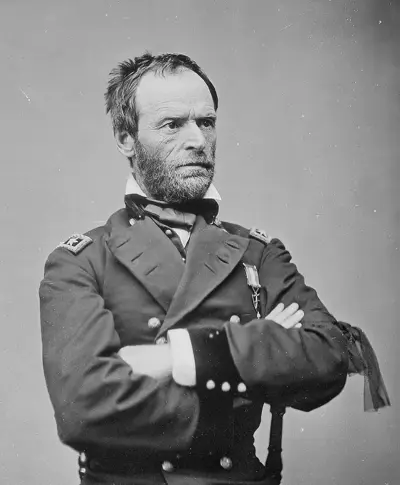
William Tecumseh Sherman Quotes
Forty or fifty executions now would in the next twelve months save thousands of lives.
Sherman was distressed at the full due process and trials that had to be given to Confederate spies and guerrillas and wanted to execute them quickly as an example. He complained to the Judge Advocate General that his men were “losing prisoners in the swamp” which both of them realized meant the immediate execution of prisoners by soldiers and junior officers which Sherman did not like either. The Lincoln administration insisted on the full due process. Even after conviction, President Abraham Lincoln tended to pardon many of the condemned.
William Tecumseh Sherman, 1820-1891, General of the Army, Letter to the Judge Advocate General during the Civil War
Sourced by: Eigen's Political and Historical Quotations
Some southerners had gotten out of the Confederate chain of command and were attacking civilian steamboats killing Southerners as well as “Yankees”. See {633900} . While Sherman had trouble with some of his own men on parts of his March Through Georgia, at this time, it was Southerners who were acting independently and improperly. Legally, the Confederates were responsible for any people committing terror. Sherman tried to persuade the Confederate commanders with letters like this, but was very quick to retaliate for every violation. He also complained to some Union officers that they were not moving quickly enough to retaliate and prevent future behavior--{584048}
The President had earlier threatened to execute Confederate prisoners, if the South implemented its threat to execute any Union Negro soldiers they captured. The threat seems to have worked. See Lincoln.
This has been the case in EVERY jurisdiction that has had capital punishment. Capital punishment does provide vengeance for victims, relatives and society. And in many societies execution is less expensive than prison for life. But it has never curtailed crime despite the example. In London, they used to have public executions as examples to inhibit crime. While the crowd was watching a pickpocket be hung, other pickpockets were relieving many spectators of their wallets and watches.
He was one of the longest serving District Attorneys in America, He also served the largest jurisdiction of a District Attorney. When he first was elected DA of Manhattan there were over 600 murders a year. When he retired, there were only about 60, a 90% reduction. Yet, his experience was that capital punishment was useless in deterring murder. He had many other techniques far more effective.
While there were atrocities committed by both sides in the Civil War, the proportion tended to be heavily weighted by Confederate perpetrations. The Confederate officers were not appointed by the command structure and under strict military discipline, but they were elected by the troops and could be so removed (except for the general officers who were appointed by the confederacy). Also, the confederate troops were not as well fed or supplied as the North and they had fewer resources with which to fulfill their obligations to prisoners. In a number of battles, ill-clothed soldiers stripped the Union dead, wounded and prisoners, often naked to use their shoes, blankets and clothing, Union prisoners of war were much more badly abused in the prisoners of war camps like Andersonville which were not under the command of Robert E. Lee.
When the Confederate Government realized that the Union was planning to arm escaped slaves and induct them into the Union Army, they quickly passed a law that declared any escaped slave who joined the Union Army or wore its uniform was guilty of Treason and would be executed. Most Union Generals one way or another got word to the Confederate Officers that they had better treat all Negro Union Soldiers as prisoners of war. Even President Lincoln warned the South. Butler, however, had a large number of Negro troops in his area and had heard threats of some of the Southerners to execute Black prisoners of war. He had a way of making things very clear, and he was able to prevent murder of any of his Negro troops despite the Treason law.
- Born: February 8, 1820
- Died: February 14, 1891
- Nationality: American
- Profession: Soldier
William Tecumseh Sherman was an American soldier, businessman, educator, and author. He served as a general in the Union Army during the American Civil War (1861–1865), receiving recognition for his command of military strategy as well as criticism for the harshness of the scorched earth policies he implemented in conducting total war against the Confederate States. British military theorist and historian B. H. Liddell Hart declared that Sherman was "the first modern general".