Wesley Clark Quotes
You can’t take military action in war without the support of government.
Wesley Clark, U. S. General and NATO Commander, Candidate for the Democratic Presidential Nomination, PBS News Hour, June 16, 2001
Sourced by: Eigen's Political and Historical Quotations


3 years later he led America on a huge invasion and nation building project in Iraq. It turned out that had he listened to his own advice and not flip-flopped, the huge cost of the Iraq War might have been avoided.


An earlier version was written by Congressman Louis L. Ludlow, 1873-1950—see his quotation about it—{39681}. The proposed amendment was narrowly defeated.

This issue of who has the wisdom and competency to determine policy in matters of war has been a constant one in most societies. Even in the Iraq war of the early 21st century, the Congress and the President argued as to what competence the Congress had to determine policy, strategy and tactics.


War and international conflict had become very complicated in modern times. Americans and most other people associated victory in war with unconditional surrender. However, since the unconditional surrender is of WWII, no conflict has ended with an unconditional surrender.

The Vietnam War was certainly not a victory for the U. S. Some saw it as our first defeat. While it was not ended on Johnson’s watch, he must certainly share that responsibility with Nixon and even JFK as these three all were responsible for our Vietnam failure. Johnson, ended up with what he feared most.


The United States should be One major problem at the time was that the Soviet Union was supporting and instigating revolutions in many parts of the world. When most nations of the UN wanted to provide peace keeping troops to quell the conflict, the Russians would veto and block the effort, Vandenberg wanted the UN to change the rules regarding the veto. The original right of veto for the major nations was originally included at the insistence of the United States and many Americans did not want to give it up or have any exceptions lest there be more. The Russians at that time also did not want to give up any of their veto powers. Another method that Vandenberg wanted to solve the Russian peacekeeping blockage problem was for America to engage in more collective security pacts so that action could be taken without UN Security Council unanimity by going around the UN.
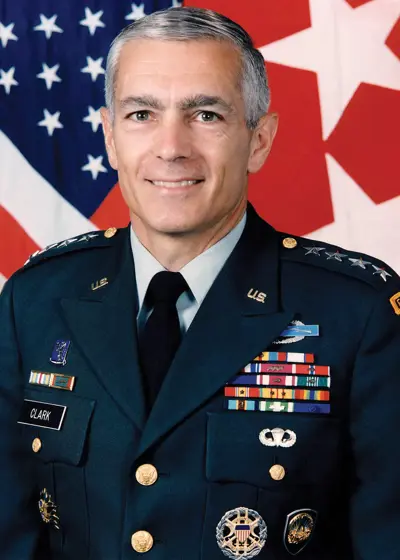
Wesley Kanne Clark, Sr. is a retired general of the United States Army. He graduated as valedictorian of the class of 1966 at West Point and was awarded a Rhodes Scholarship to the University of Oxford, where he obtained a degree in Philosophy, Politics and Economics. He later graduated from the Command and General Staff College with a master's degree in military science. He spent 34 years in the U.S. Army, receiving many military decorations, several honorary knighthoods, and the Presidential Medal of Freedom.
