Stand Watie Quotes
Quantrill crossed the Arkansas river near the Creek Agency and killed eight men (Creeks). One of them shot a little boy and killed him. Some of the Creeks who were along returned today and brought this news. I have always been opposed to killing women and children although our enemies have done it, yet I shall always protest against any acts of that kind.
The Creeks—the Cherokee traditional rivals and enemies were under a different command but all the other Indians were under Stand Watie’s command. In this quotation, we see the negative reaction that many Southerners had toward Quantrill and his cutthroats. This quote and others show that the Quantrill atrocities were generally known throughout the South. The Confederate command structure however, did nothing to rein in Quantrill’s atrocities much less discipline him for his war crimes. It is not clear to whom Waite referred as “enemies”—the Union troops or the Creeks, their traditional enemies. The slavery issue of the Civil War divided more than the nation. The Cherokee’s were badly divided over social class, aristocracy, strategy in keeping their land and tribal sovereignty, and slavery. A number of the older families had Black slaves. Stand Waite was one of the old, traditional, Cherokee, families, who were not happy losing their traditional power and influence when Jon Ross was elected tribal leader. He and his majority faction would not support the South in the Civil War. Stand Waite did, and after Ross was murdered Waite became the Second Cherokee Tribal leader.
Stand Watie, 1806-1871, Cherokee Indian Confederate General in Command of the Indians who sided with the Confederacy, 2nd Tribal Leader of the Cherokees, Letter to his wife, April 24, 1864
Sourced by: Eigen's Political and Historical Quotations

Roger’s Rangers of the French & Indian War were the first using unconventional warfare and invented the “deep raid” when they went in stealth all the way to Quebec and defeated the Abnaki Indians in their home village rather than defend against the Indians’ French coordinated attacks on upper York State. Rogers was portrayed by Spencer Tracy in the film Northwest Passage depicting the raid. All the men were killed but the women and children were captured and released with the exception of 5 teenagers who the Rangers took with them. This was one of the first formal “Rules of War” in what was otherwise a viciously uncivilized war.


To this day there is a large stature of Montecino prominent in the skyline of Santo Domingo.
Referring to the behavior of English King Edward I, 1239-1307, towards Scotland:


Lawrence of Arabia. In the Middle East, Lawrence led a small Arab army against the Turks and the Germans. In a battle near Tafas, the captured 250 Turkish and German soldiers as prisoners. They them shot them all in cold blood with their Hotchkiss machine gun. What makes this quotation so significant is that one of the great British heroes of WWI was actually guilty of War Crimes. An American journalist gave Lawrence and his exploits great publicity without mentioning the atrocities. The British chain of command also ignored the transgression of one of the most fundamental rules of war even though the clear evidence was in basic battle report files. However, the British never removed the report from the files or destroyed it. The Turks and the Germans while they respected the rules of war with the English, French, and most allies, treated the Arabs much more harshly and murdered Arab prisoners on many occasions. In part this atrocity at Tafas was an act of vengeance and retaliation. But Lawrence never even tried to explain it.

Howe had written Franklin attempting to stave off a American break with England. Franklin, with the approval of the Continental Congress, replied.

While there were atrocities committed by both sides in the Civil War, the proportion tended to be heavily weighted by Confederate perpetrations. The Confederate officers were not appointed by the command structure and under strict military discipline, but they were elected by the troops and could be so removed (except for the general officers who were appointed by the confederacy). Also, the confederate troops were not as well fed or supplied as the North and they had fewer resources with which to fulfill their obligations to prisoners. In a number of battles, ill-clothed soldiers stripped the Union dead, wounded and prisoners, often naked to use their shoes, blankets and clothing, Union prisoners of war were much more badly abused in the prisoners of war camps like Andersonville which were not under the command of Robert E. Lee.


Paul tended to be one of the very few Republicans who did not favor American intervention in Syria.

The term “your” referred to the imperialists in America who were supporters of the war in the Philippines. There were some unfortunate atrocities committed by American officers. See General Jacob H. Smith: {42097}.

One of the must difficult ethical problems is raised in wartime, when one side uses its homes and civilian institutions to store arms and ammunition and house fighters. By international law religious institutions, hospitals, schools and homes forfeit their status when there are fighters in them or weapons are therein. For most American Indians there was no concept of military facilities as separate from civilian, unlike many Arabs of the 20th and 21st century where the military fighters deliberately choose these civilian facilities to fight from. See General Sherman’s reply {617990}.

The soldiers obeyed their orders and killed every man, woman and child they could find outside the city. They beheaded captured prisoners, bayoneted pregnant women and children. All civilian houses were burned, often with the people trapped inside.


The Congresswoman was referring to the fact that the U. S. Defense Department had trained Indonesian military officers who had leadership roles in the massacres and other human rights violations in East Timor in 1999.


Wherever there has been a true free press, there have been anti-war activists who are particularly critical of the affect on civilians—collateral damage or otherwise.


Yuliy Osipovich Martov. Criticism of the Bolshevik behavior in dealing with counter-revolutionaries in the civil war that followed the Russian Revolution. This despite the fact that the death penalty had been abolished right after the Revolution. See {590510}

Roosevelt had little respect for Miles who was an enemy of the President’s. Incredibly enough, Roosevelt wrote this sentence in a letter to the general. However, the President’s aids persuaded him not to send the letter not only because it was so confrontational with Miles but it was a Presidential admission that there had been a “massacre” for which the United States military was responsible. For a parallel situation in World War II England, see Winston Churchill {597711}. Roosevelt remembered the incident and later when Miles stepped out of line, Roosevelt ended the general’s career—see {589012}. This quotation when considered against the {588991} quotation demonstrates the very complex nature of TR’s character and views. He did not like Indians and had disparaged them and commented that dead Indians were good Indians. Yet he had a very strong sense of honor and was greatly offended by the massacre of unarmed Indians and women and children.

3rd Earl Russell of Kingston
When the Confederate Government realized that the Union was planning to arm escaped slaves and induct them into the Union Army, they quickly passed a law that declared any escaped slave who joined the Union Army or wore its uniform was guilty of Treason and would be executed. Most Union Generals one way or another got word to the Confederate Officers that they had better treat all Negro Union Soldiers as prisoners of war. Even President Lincoln warned the South. Butler, however, had a large number of Negro troops in his area and had heard threats of some of the Southerners to execute Black prisoners of war. He had a way of making things very clear, and he was able to prevent murder of any of his Negro troops despite the Treason law.
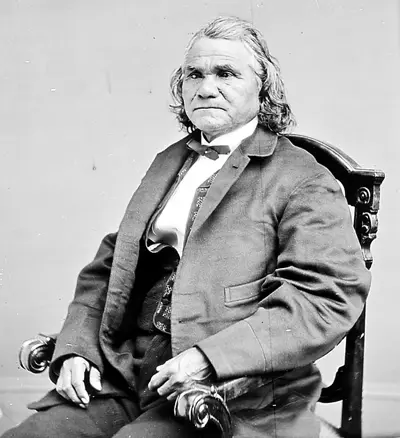
Stand Watie (Cherokee: ᏕᎦᏔᎦ, romanized: Degataga, lit. 'Stand firm'), also known as Standhope Uwatie, Tawkertawker, and Isaac S. Watie, was a leader of the Cherokee Nation. The nation allied with the Confederacy, and he was the only Native American to attain a general's rank in the Civil War, Confederacy or Union. He commanded the Confederate Indian cavalry of the Army of the Trans-Mississippi, made up mostly of Cherokee, Muskogee and Seminole. He was the last Confederate general in the field to cease hostilities at war's end.
