Winston Churchill Quotes
It seems to me that the moment has come when the question of bombing of German cities simply for the sake of increasing the terror, though under other pretexts, should be reviewed. Otherwise we should come into control of an utterly ruined land.
60,000 English men, women, and children had been killed by German terror bombing of London and other English cities. The policy had been to retaliate and bomb German population centers. Over 4 million British homes had been destroyed by the blitz and Churchill was becoming concerned that when the Allies would occupy Germany shortly, there would be no German housing left for the civilian population much less for the Allied occupying forces. Churchill’s Air Attaché persuaded him NOT to send the memorandum with it’s references to the terror bombing in retaliation. The memorandum was rewritten with the references to “terror” removed. The bombing of cities did stop as a result.
Winston Churchill, 1874-1965, British Prime Minister (Conservative), Secret Memorandum to General Ismay and the COS Committee March 28, 1945
Sourced by: Eigen's Political and Historical Quotations

Roosevelt had little respect for Miles who was an enemy of the President’s. Incredibly enough, Roosevelt wrote this sentence in a letter to the general. However, the President’s aids persuaded him not to send the letter not only because it was so confrontational with Miles but it was a Presidential admission that there had been a “massacre” for which the United States military was responsible. For a parallel situation in World War II England, see Winston Churchill {597711}. Roosevelt remembered the incident and later when Miles stepped out of line, Roosevelt ended the general’s career—see {589012}. This quotation when considered against the {588991} quotation demonstrates the very complex nature of TR’s character and views. He did not like Indians and had disparaged them and commented that dead Indians were good Indians. Yet he had a very strong sense of honor and was greatly offended by the massacre of unarmed Indians and women and children.

On March 9-10, 1945, over three hundred B-29 Superfortresses loaded with 2,000 tons of incendiary bombs flew over Tokyo bombing the city in waves for 6 hours. Over 250,000 buildings were destroyed and more people were killed than would be in either Hiroshima or Nagasaki which were destroyed by atomic bombs. See {615730} and {615733}. The technique called area bombing was then implemented on Japanese cities 66 more times. Stimson was seriously worried that there would be no large targets in Japan left on which the dramatic effect of the atomic bomb could be demonstrated. And without such a demonstration, there would not be a likely Japanese surrender as all the devastating conventional bombing had not persuaded the Japanese. A land invasion with perhaps millions of casualties might be required.


This may have been one of the most indelicate and insensitive true public statements ever made by a politician. The English population and their political representatives were angry and worried very much that bombing of cities might become a German pattern (which it did.)


The British and American bombing of Germany had become so effective that most of the German industrial system was destroyed. However, early in the War, Germany had violated the Geneva Convention and was indiscriminately bombing London and other part of England. In addition the German Air Force had bombed Warsaw, and many other cities throughout Europe. The German’s had killed over 20 million Europeans. When the Allied bombing produced high collateral damage against civilians, some argued that even though German had deliberately used this tactic, the allies should stop the saturated bombing if there were to be high civilian collateral damage. Others argued that it was unfortunate but a military necessity. There were others like Brenen, who argued that killing German women and children was desirable and just.

Bombing had reached the point where conventional bombing raids on industrial cities like Tokyo and Hamburg produced even more civilian casualties than did the atomic bomb at Hiroshima. Tibbets’ view, through the lens of hindsight, was developed by many of the Allied servicemen who had been forced into war by expansionist and militaristic nations like Japan and Germany both of which placed much of their war material manufacturing capability in the midst of their otherwise civilian cities. Both brutally violated the laws of war and committed atrocities many times over before the allies began retaliating. There are still some who believe that it was wrong to drop the atomic bomb on Japan. Some even feel that the mass bombing of Japanese and German cities in retaliation and in furtherance of the war effort was morally wrong. But at the time, the millions of casualties anticipated in the invasion of the Japanese mainland, persuaded virtually every American soldier and civilian that there was nothing wrong with use of the Atomic bomb, and many saw it as an absolute Godsend to prevent all the American and Japanese causalities that would have come otherwise. Many scholars remark on how it was virtually impossible to find any significant number of misgivings before or just after Hiroshima. Tibbet’s view was typical.


One of the predictions of the oncoming war with Germany.


Bosnian Serbs took United Nations peace keepers hostage in 1995.

John E. Puerifoy, the American ambassador to Guatemala

In WWII the Germans bombed London causing many civilian casualties. In retaliation, the allies bombed German cities such as Hamburg and others. The resolution’s effect was very short lived. There are similar restrictions in the Geneva Conventions but again, if one side breaks the conventions, most other sides will retaliate. Note that in the 3rd condition, the one that is most contentious in the 21st century “negligence” is the operative word. An error or mistake is not necessarily or even usually negligence. Many people believe that international law prohibits the bombing of civilians from reading 3) and similar statements from treaties. However, an honest error, mistake or equipment malfunction which kills
At Hamburg Harris organized a massive fire bombing of the German industrial city and the fire storm was so great that it sucked the oxygen out from huge sections of the city and thousands of people were roasted alive. Even with 100,000 Germans killed, Harris was convinced that it was a relatively humane way of waging a necessary war when compared to the classic artillery barrage followed by invading soldiers and street to street fighting.
The culture of Iraq and the Desert tribes made raiding and looting of other villages or travelers or caravans a way of life. The British occupiers were determined to put an end to it and Harris, a young officer, developed the retaliation of bombing the village of the raiders and their warlords. This appears to be the beginning of destroying of houses in the Middle East as a method of retaliation and punishment which would be adopted so well by the Israelis as a humane method and they often quoted Harris saying: “we put them to the maximum amount of inconvenience, without physical hurt, and they soon stopped their raiding and looting.”


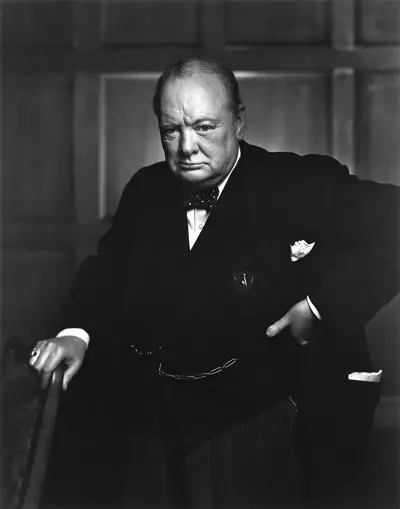
- Born: November 30, 1874
- Died: January 24, 1965
- Nationality: English
- Profession: Statesman
Sir Winston Leonard Spencer Churchill, KG, OM, CH, TD, DL, FRS, RA was the Prime Minister of the United Kingdom from 1940 to 1945, during the Second World War, and again from 1951 to 1955. Apart from two years between 1922 and 1924, Churchill was a Member of Parliament (MP) from 1900 to 1964 and represented a total of five constituencies. Ideologically an economic liberal and imperialist, he was for most of his career a member of the Conservative Party, as leader from 1940 to 1955. He was a member of the Liberal Party from 1904 to 1924. Churchill was also well known for his military career and as a historian, painter and writer, and among his many awards was the Nobel Prize in Literature.
