Benjamin Rush Quotes
There are nearly as many officers as men in our army. Every Regiment has a Surgeon with one or two mates. Each of these (officers--Surgeons & mates) has a Servant drawn from the ranks to attend them who is always exempted on this acct. from camp & field duty. I have been told the General [Washington]. has forbidden it a hundred times in GENERAL ORDERS. But the evil continues, & no wonder, for Officers ride up to his quarters with soldiers behind them in the capacity of servants.
Rush ran the hospitals for the Revolutionary Army and talked to many officers and enlisted men, and also observed much of the British military practices. This is a fascinating quotation because it discusses a problem of the early American Military which has been a constant throughout history: Generals and Admirals using soldiers and sailors as personal servants and retinue. While there have been Generals like Horatio Gates, Omar Bradley and Dwight D, Eisenhower and others of every era who did not take advantage of their power to obtain this personal aggrandizement, many have and continue to use their position to obtain personal perks.
Benjamin Rush, 1745-1813, Physician & member of the Continental Congress, Surgeon General of the Continental Army and Treasurer of the U.S. Mint, Letter to John Adams, October 21, 1777
Sourced by: Eigen's Political and Historical Quotations

Rush ran the hospitals for the Revolutionary Army and talked to many officers and enlisted men, and also observed much of the British military practices. These suggestions were discussed but never passed as regulations. They are fascinating insights into the problems of the general officers of the time who were generally selected for their socioeconomic status rather than other qualifications. Note the drunkenness limitation for a commanding general was proposed to be limited to only 1 allowed bout of drunkenness every 24 hours. It was, he thought, totally unrealistic to require generals to be always sober when on duty. With the mediocre quality of senior officers, Washington had to depend on foreigners like Lafayette, Von Steuben and others. And Generals who were leading attacks out in front of their men like Benedict Arnold immediately became heroes and one of the reasons he ended up as a traitor was that he thought that he was badly treated relative to the “society” Generals who would not accept him and denigrated his exploits when they themselves had never been close to a battle front.


From the beginning, the issue of whether the country should have a standing army or depend on the militia and the citizen soldier has been controversial. There is a , romantic American myth about the Militiamen in Colonial and Revolutionary America—the citizen soldiers who would leave their farms and rise to the military necessity of the day. However, not only were the militia very hard to muster to duty, but most actually didn’t own or have experience with firearms, and the prevailing opinion of knowledgeable military leaders from George Washington on down was that the militia were not very good soldiers. See {613015}, {613016}, {613022}, {613027}, {621987}, {621988}, {613030}, {613033}, & {613056}

Von Stuben brought a formal discipline and organization to the American army and is referred to as “The Father of the U. S. Army.” Beaumarchais was a leading dramatist as well as a secret agent and his communiqués were doubtless the most flowery in the history of espionage and spying.

See {629263} for more on the “Gentleman” Southern officers.

Eggleston was an accomplished writer who had served in the Confederate army of the Civil War. 20 year after the war he wrote a series of articles for the prestigious Northern Atlantic Monthly trying to convey the war from the Southerner’s point of view.
General Howe was the Commander of British Troops in the American Revolution. The early American Army was neither professional, experienced, or well officered. Execution as a means of punishment was much more common than in the larger, professional British army. Rush ran the hospitals for the Revolutionary Army and talked to many officers and enlisted men, and also observed much of the British military practices.

Mechanics was a general term for people who made things, or fixed things. Ramsay was the first major historian of the American Revolution.
Conway was made a Major General by Congress and appointed as Inspector General of the Revolutionary Army. However, then as now, officers who told the truth about the failings of other senior officers were not well liked by the officer corps. The cover up was the norm even then. Rush ran the hospitals for the Revolutionary Army and talked to many officers and enlisted men, and also observed much of the British military practices.
This is an aspect of the American Revolution that is rarely described in American history books. Rush ran the hospitals for the Revolutionary Army and talked to many officers and enlisted men, and also observed much of the British military practices.

Socioeconomic class was a major factor in the Continental Army just as it was in the British Army. New York, unlike New England, did not have the clear-cut majority in favor of independence. Most of the working class at this stage had no opinion on independence as they did not need to and were not of the social class that had been discussing and arguing about the relationship with England. The upper class had been discussing the issue for some time and were polarized into Patriot and Loyalist sympathies. When the Patriots of New York voted to raise its first Regiment, the first people to volunteer were the men of the upper class who had been debating the question for some time. Because of their social class, they had to be officers. The lower classes got into the intellectual and political debate later, and they too were divided. The Patriots among them then volunteered to provide the privates and other enlisted men to the NY regiment. But the early contingents of New Yorkers were very top heavy with officers. While not as rigid as the Continental Army, the modern American Armed Services are still affected by this tradition. While there are many exceptions, there is still a strong correlation between military rank and socioeconomic family status.

Men were being recruited to volunteer for the new American Revolutionary army throughout the colonies. However, the sons of many Virginia planters were neither recruited, nor did most of them volunteer. The reality was that few of them had an education that might fit them for many of the military needs. However, they were not very fit to be foot-soldiers (infantry) as they were mostly, having lived on a slave plantation where they did not work and were truly indolent and would not have the discipline or endurance to march long distances. Jefferson came up with this idea: Create a special Cavalry unit. They could all serve together and would not be a bad example to other men, and they all could ride a horse as that was their primary mode of transportation. This is another of the examples negative effects on whites what Negro slavery wrought.

During the American Revolution, conditions were very difficult for Washington’s soldiers who were ill armed, ill clothed, and ill fed while they were paid irregularly. At one point morale was so low that some of the soldiers revolted. Smyth observes that Washington and Congress disciplined the mutineers very mildly, especially when compared with the way the British would deal with such things. The British Governor Clinton tried to take advantage of the mutiny and the poor morale by announcing that all of Washington’s troops who wished could obtain amnesty and join the British forces where the pay and conditions were much better. Professor Smyth found it fascinating that none of the Americans would join the British and he credits it to the wise and mild discipline policies of Washington and Congress as well as the general perception of the justice of the American cause among the American troops.

This quotation is interesting for two reasons. First, this is one of the most severe criticisms of a cabinet and ministers in English history. The second reason of interest is that it was these same ministers who made the policies and the decisions that would bring on the American Revolution. Were it not for the incompetence, there might not be a United States today. Pitt’s son later also castigated the ministers. See {641503}.


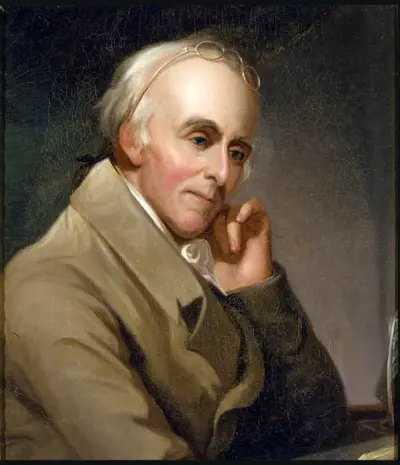
Benjamin Rush was a signer of the United States Declaration of Independence and a civic leader in Philadelphia, where he was a physician, politician, social reformer, humanitarian, and educator and the founder of Dickinson College. Rush attended the Continental Congress. His later self-description there was: "He aimed right." He served as Surgeon General of the Continental Army and became a professor of chemistry, medical theory, and clinical practice at the University of Pennsylvania.
