Thomas A. Edison Quotes
In 'Common Sense' Paine flared forth with a document so powerful that the Revolution became inevitable. Washington recognized the difference, and in his calm way said that matters never could be the same again.
Edison, Thomas A. Introduction. The Life and Works of Thomas Paine, by William M. Van der Weyde, Thomas Paine National Historical Association, 1925, p. ix.


This was not exactly a complement. Adams was outraged by Paine’s overt and public atheism and anti religious statements. (See {623040}.) Others of the founding fathers were also atheists but Paine wrote publicly and actively tried to persuade people of his religious position. Adams was particularly concerned because Paine was not just one of the great leaders of the American Revolution. His was the most recognized name, and a huge percentage of the American population had read his Common Sense. He was the person who was most persuasive with the mass of Americans to revolt—more so than Jefferson, Washington, Madison, Franklin or any of the other great men of the time. Because Paine was so influential, Adams thought that he should be more passive in shaking the religious faith of so many others. Actually, it was Paine’s overt atheism that has tended to diminish his influence and status given by historians throughout the ages. It also caused him some difficulty in America after the Revolution and moreso in England.


Franklin himself was a great writer and publisher. However Paine was so extraordinarily great as a writer that he not only expressed the basic ideas of the Founding Fathers and the ideals of the American Revolution better than anyone else, but his “Common Sense” was not only an intellectual, critical, political, and propaganda success, but it was the best selling publication in America. Imagine a political tract of today outselling all the novels, dictionaries and Bibles. Arguably, “Common Sense” was the greatest commercial publication in American history. No single, specific publication since has reached a greater proportion of citizens of the nation. And it was sold commercially, not given away.


Welliver was the first of the American presidential speechwriters. President Harding was the one who used the term in public.
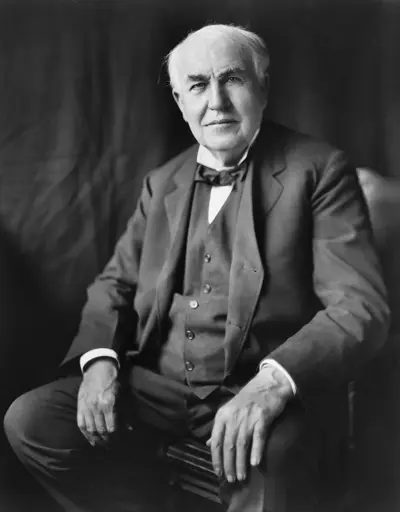
Thomas Alva Edison was an American inventor and businessman who has been described as America's greatest inventor. He developed many devices in fields such as electric power generation, mass communication, sound recording, and motion pictures. These inventions, which include the phonograph, the motion picture camera, and early versions of the electric light bulb, have had a widespread impact on the modern industrialized world. He was one of the first inventors to apply the principles of organized science and teamwork to the process of invention, working with many researchers and employees. He established the first industrial research laboratory.
