Benjamin Rush Quotes
Scandal dies sooner of itself, than we could kill it.
Rush, Benjamin. The Autobiography of Benjamin Rush: His "Travels Through Life" together with his Commonplace Book for 1789-1813. Edited by George W. Corner, Princeton University Press, 1948, p. 320.


This quotation is the root of a great dilemma for all politicians who are attacked on a personal level. Most slanders are soon forgotten. The politician who reacts and publicly counters the slander inevitably does two things. More people become aware of the slanderous charges then there is a public battle over it, and the media tend to report the contest and hence the slanderous charge for a longer period of time than if it were uncontested. However sometimes the undefended charge is perceived as being true especially if it is a major charge. If the politician does not defend, the charge can get accepted and damage the politician’s standing. In the Kerry-Bush Prudential campaign, Kerry had the edge until the so-called Swiftboat Veterans made up a fictitious tale of Kerry, a decorated war hero, being a coward in the Vietnam war. Kerry thought the charge so preposterous that he didn’t bother to defend it. His lack of reaction was taken by much of the public as his admission of the charge. Kerry’s hero image was destroyed by a large enough proportion of the electorate that the electoral votes shifted to Bush, even though Kerry had the most votes by far. For each politician, the decision must be made for each charge and there is no clear way to know in advance which is the better strategy when a false charge is made.


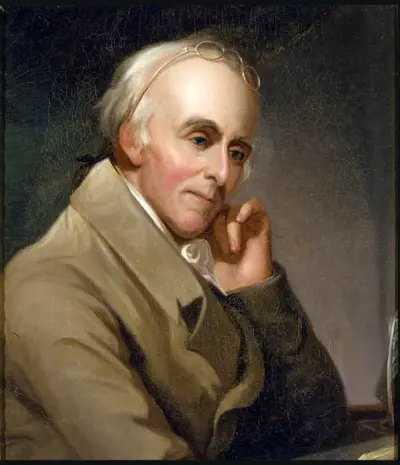
Benjamin Rush was a signer of the United States Declaration of Independence and a civic leader in Philadelphia, where he was a physician, politician, social reformer, humanitarian, and educator and the founder of Dickinson College. Rush attended the Continental Congress. His later self-description there was: "He aimed right." He served as Surgeon General of the Continental Army and became a professor of chemistry, medical theory, and clinical practice at the University of Pennsylvania.
