Benjamin Rush Quotes
I think a people cannot be long free, nor ever happy, whose government is in one Assembly…. A single Assembly is liable to all the vices, follies and frailties of an individual,--subject to fits of humor,--starts of passions, flights of enthusiasm,--partialities of prejudice, and consequently productive of hasty results and absurd judgments. All these errors ought to be corrected, and defects supplied by some controlling power. A single Assembly is apt to be avaricious, and in time will not scruple to exempt itself from burdens, which it will lay, without compunction, upon its constituents. A single Assembly is apt to grow ambitious, and after a time will not hesitate to vote itself perpetual.
The Congress and most of the State Legislatures are bicameral (two houses). Nebraska has only a unicameral (one house) legislature.
Benjamin Rush, 1745-1813, Physician & member of the Continental Congress, Surgeon General of the Continental Army and Treasurer of the U.S. Mint, Observations on the Government of Pennsylvania, 1777
Sourced by: Eigen's Political and Historical Quotations


With a legislature of two houses, both have to agree to any change in order for it to take effect. This is always harder to do than to have change voted by a single legislative body.


His main reason for believing this is that all appropriations bills must be initiated by the House of Representatives. Lobbyists therefore often give the House more attention than the Senate.


President Abraham Lincoln had pocket vetoed his own party's reconstruction bill in the midst of an election year.


See Louis Brandeis for a later judicial interpretation of this view.


Morris had it wrong. He perceived that the Senate could not be a check on the House or the President because to him, the Senate was the house of aristocrats and America really did not have aristocrats since there was no nobility so that there would be no difference between Representatives and Senators-–they both were drawn from the same egalitarian population. He missed however that the Senate, being elected by states, would represent a broader constituency than a member of the House, and because of this broader perspective, would come to see issues in nationalist and state terms while Representatives would perceive the same issues in local terms. Hence the two houses of Congress became effective checks on each other, and the Senate on the President because not of different social or economic class, but of broader and narrower perspectives. It was not what Senators were but what they would become once they were elected and had to be reelected.

This constitution was written 7 years before the national constitutional convention. It shows that there was concern about the separation of powers in United States even before the Constitution was drafted. See {616750} for an even clearer statement of the separation of powers principle.

This was the President’s original role regarding legislation. However, in the 20th century, Presidents have become more active and suggest laws and often initiate the process and then end it by signing the law that he suggested and shepherded through the Congress. But this was never the vision of the Founding Fathers, but since it is not addressed in the Constitution is not an unconstitutional process.

If a party controls one of the two houses of Congress, they can block any legislation. But governing involves passing legislation, and in our bi-cameral Congress, control of one house is not sufficient to pass legislation.


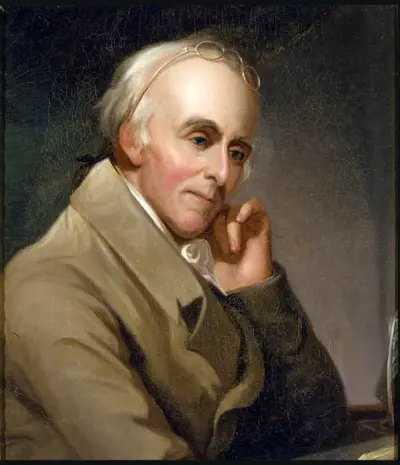
Benjamin Rush was a signer of the United States Declaration of Independence and a civic leader in Philadelphia, where he was a physician, politician, social reformer, humanitarian, and educator and the founder of Dickinson College. Rush attended the Continental Congress. His later self-description there was: "He aimed right." He served as Surgeon General of the Continental Army and became a professor of chemistry, medical theory, and clinical practice at the University of Pennsylvania.
