Gouverneur Morris Quotes
The Senate, in my poor opinion, is little if any check, either on the President or the House of Representatives. It has not the disposition. The members of both Houses are creatures, which, though differently born, are begotten in the same way and by the same sire. They have of course the same temper. But their opposition, were they disposed to make any, would be feeble. They would easily be borne down by the other House, in which the power resides. The President can indeed do what he pleases, provided always it shall please him to please those, who lead a majority of the Representatives.
Morris had it wrong. He perceived that the Senate could not be a check on the House or the President because to him, the Senate was the house of aristocrats and America really did not have aristocrats since there was no nobility so that there would be no difference between Representatives and Senators-–they both were drawn from the same egalitarian population. He missed however that the Senate, being elected by states, would represent a broader constituency than a member of the House, and because of this broader perspective, would come to see issues in nationalist and state terms while Representatives would perceive the same issues in local terms. Hence the two houses of Congress became effective checks on each other, and the Senate on the President because not of different social or economic class, but of broader and narrower perspectives. It was not what Senators were but what they would become once they were elected and had to be reelected.
Gouverneur Morris, 1752-1816, U. S. Commissioner to England & U. S. Minister to France, U. S. Senator (Federalist, NY), Letter to Robert Walsh, February 5, 1811
Sourced by: Eigen's Political and Historical Quotations

His main reason for believing this is that all appropriations bills must be initiated by the House of Representatives. Lobbyists therefore often give the House more attention than the Senate.

The Chairmen of the Committees then had tremendous, almost unilateral power. The chairman reached seniority by being elected over and over and had little opposition. At the time they were almost all older Democratic Congressmen from the "Solid South", very conservative and still racists despite the 1964 Civil Rights Act. They were outraged when a Freshmen member of Congress who rarely made a public statement, took on the most powerful members of the House and wanted to reform the Seniority. But Ms. Chisholm was a teacher in her professional life, and by challenging the seniority system and attracting the enmity of most of the Chairmen, the media and the public started to cover the dispute and Chisholm explained to America exactly how the system worked and how undemocratic and racist it was. Her effort put the Seniority System on the public agenda, and reforms evolved over the next decades." She was the first Black woman to be elected to Congress and was the first Black woman to actively campaign for the Presidency


If a party controls one of the two houses of Congress, they can block any legislation. But governing involves passing legislation, and in our bi-cameral Congress, control of one house is not sufficient to pass legislation.

Monroe was then Secretary of State.

His role was the equivalent of the Mayor of Washington DC. Even though the Congress had generally been the most powerful branch of the government, public opinion on this was beginning to shift at the turn of the 20th century.


Vidal, a staunch liberal held this view along with many ultra conservatives end extreme liberals. The constitution requires the Congress to declare war, but they have not done so for any of the wars since WWII. The President assumed the war power. And the only coherent budgets began.

This was the President’s original role regarding legislation. However, in the 20th century, Presidents have become more active and suggest laws and often initiate the process and then end it by signing the law that he suggested and shepherded through the Congress. But this was never the vision of the Founding Fathers, but since it is not addressed in the Constitution is not an unconstitutional process.

This letter was written shortly after the Constitution had been signed by the convention delegates. This difference between Adams and Jefferson would be at the heart of the first great partisan struggle in American history. Adams, as the second President, tried to increase and use the power of the Presidency. Jefferson opposed him, especially when Adams tried to run for a second term. The Adams-led Federalists were pitted against Jefferson’s Democratic Republicans in the first, and perhaps still the most bitter partisan struggle in American political history. The Jeffersonians accused Adams and the Federalists of trying to unravel the American Revolution and revert to a monarchy. The people not only sided with the Democratic Republicans, ousting Adams, but also turned out most of the Federalists. It was the end of the Federalist Party, and a new conservative party—without monarchial tendencies—the Whigs became the new opposition party.


The 534 he referred to were the Members of Congress.

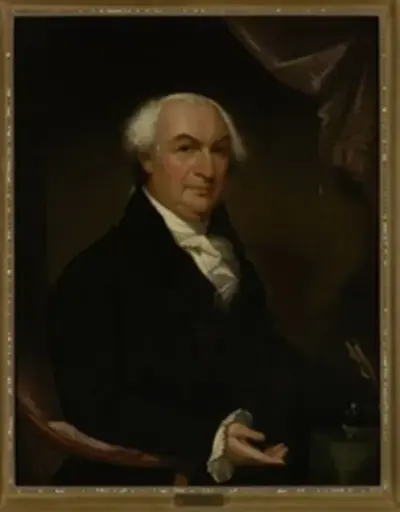
Gouverneur Morris was an American statesman, a Founding Father of the United States, and a signatory to the Articles of Confederation and the United States Constitution. He wrote the Preamble to the United States Constitution and has been called the "Penman of the Constitution." In an era when most Americans thought of themselves as citizens of their respective states, Morris advanced the idea of being a citizen of a single union of states. He was also one of the most outspoken opponents of slavery among all of those who were present at the Constitutional Convention. He represented New York in the United States Senate from 1800 to 1803.
