Benjamin Rush Quotes
I was … struck with their [the British] attention to SECRECY in all their operations. I was confined upon parole to the district where our wounded lay, and when the whole army marched by my lodgings I was confined by an officer to a back room. They lock up the houses of every family that is suspected of being in the least unfriendly to them in their marches thro' the country, & if they are discovered by a countryman whom they suspect, they force him to accompany the army 'till their route or disposition are so far changed that no mischief can arise from the intelligence he is able to convey.
Adams was then in the Continental Congress and he and other patriots were learning as much about military methods as possible. For many, secrecy was an entirely new concept. Rush ran the hospitals for the Revolutionary Army and talked to many officers and enlisted men, and also observed much of the British military practices.
Benjamin Rush, 1745-1813, Physician & member of the Continental Congress, Surgeon General of the Continental Army and Treasurer of the U.S. Mint, Letter to John Adams, 1777
Sourced by: Eigen's Political and Historical Quotations

The FBI director had become so powerful and unchecked by Congress or the President he used the FBI to assemble files on those whom he wanted including political figures. On many occasions he used these for various forms of blackmail, never for money, but to solicit compliance or support or obtain silence or cessation of opposition to positions he favored—especially the prerogatives of the FBI.


Responding to suggestions that with the demise of the Berlin Wall the spying business will come to a halt: John Moore Cornwell


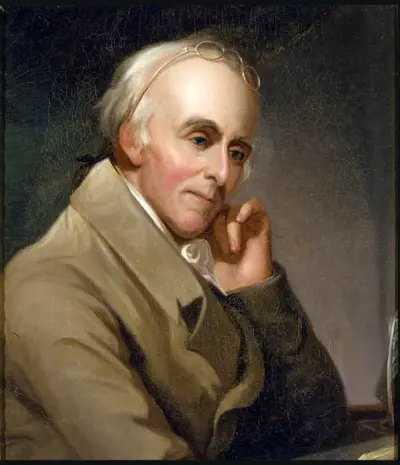
Benjamin Rush was a signer of the United States Declaration of Independence and a civic leader in Philadelphia, where he was a physician, politician, social reformer, humanitarian, and educator and the founder of Dickinson College. Rush attended the Continental Congress. His later self-description there was: "He aimed right." He served as Surgeon General of the Continental Army and became a professor of chemistry, medical theory, and clinical practice at the University of Pennsylvania.
