Benjamin Rush Quotes
Have you not violated a fundamental principle of liberty in excluding the clergy from your Legislatures. I know their danger in a free government but I would rather see them excluded from civil power by custom than by law. They have property, wives & children, & of course are citizens of a community. Why therefore Should they be Abridged of any one privilege which Other citizens enjoy? Is it not a fact that by investing any men with more, or confining them to fewer privileges than members of a community enjoy in general we render those men the enemies of that community Perhaps all the Mischief which the clergy have done in all countries has arisen from the first of the above causes. Will not the clause in your Charter which excludes Clergymen from your Legislature hand down to posterity as well as hold up to the World an idea that you looked upon the Christian religion as well as its Ministers as unfriendly to good government? I wish our governments would treat religion of all kinds, & ministers of all denominations as if no such things or beings existed in the world. They mutually destroy each Other when any Attempts are made by either to support each other...
At the beginning of our nation, before there was a Constitution, the state of Virginia prohibited clergy from serving in the state legislature.
Benjamin Rush, 1745-1813, Physician & member of the Continental Congress, Surgeon General of the Continental Army and Treasurer of the U.S. Mint, Letter to Patrick Henry, July 16. 1776
Sourced by: Eigen's Political and Historical Quotations


A conservative Calvinist weekly periodical. At the time the term “Turk” referred to all Muslims as the Turkish Ottoman Empire controlled most Muslim countries.

Lopez and Elizer were Jews who had escaped the persecution in Portugal to come to America. They and other non-Christians could live and work in Rhode Island but could not vote or hold public office by a previous decision of the Rhode Island Assembly. See {619707}.The Jews had petitioned for their civil rights.

There was freedom of religion for Protestants in early New Jersey. Note that Catholics and Jews were not allowed to hold office. This constitution was in force until 1844 when the prohibition was repealed by new constitution. Under the original constitution, men were convicted for blasphemy. See {621063} .


The then current example was with same sex marriage. Some people who claimed that their religion declared same sex marriage as a sin and prohibited their aiding and abetting that activity. As a result, they claimed that their right of religious freedom allowed a county clerk to refuse to issue the marriage license or a hotel to refuse to allow a gay couple to rent their facility for a wedding, or a retail store to refuse to sell the couple bedding.

This is one of the earliest expressions of the first regarding freedom of religion. Note that there was concern about the possible government negative effects on religion as well as the other way around. The Continental Congress was very disparate & often inconsistent. Four months after this passed, the Continental Congress voted to have & pay Christian Protestant Chaplains for the army despite a critical shortage of funds. Further they ordered Washington to require the troops to attend Christian religious services which the General did. After this statement, many Protestant clergy objected. Congress actually depended on the clergy to communicate with the public & prepared many open letters which the asked the clergy to read from the pulpit—especially ones recruiting troops. With the Revolution going badly, the Congress & Washington did not want a dispute with the clergy many of whom were already being pressured against the revolution by their religious superiors in England.


Pen name: Jack Nipps


The treaty, which was also ratified by the Senate, was actually drafted by Joel Barlow, the U. S. Consul in Tripoli. It was the first official statement of the United States on its religious basis or lack thereof.


The wording was rejected and the delegates insisted upon the original proposed language: “Well aware that Almighty God hath created the mind free …” This is a very important historical quotation because it shows that Henry and a few others wanted to make the society Christian centric, However, the majority insisted that it be non-sectarian. Many of the delegates rejecting the “Jesus Christ” language were themselves practicing Christians, but they were aware of the terrible religious wars and strife in Europe and between Christians and Muslims as well as the persecution of Jews, Quakers, and other sects; they did not want that in America so they rejected the idea of an established Christian Church or culture.

Of all the Western Colonial Powers, Spain was the worst. They took the most from their possessions and contributed the least. Worst, they killed off almost all the indigenous people.

Williams was the first theologian who not only advocated religious toleration but argued that Christianity demanded it and the separation of church and state.


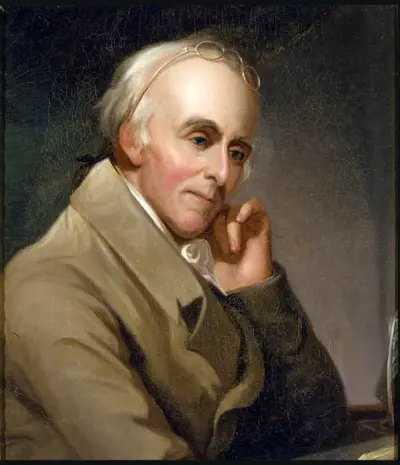
Benjamin Rush was a signer of the United States Declaration of Independence and a civic leader in Philadelphia, where he was a physician, politician, social reformer, humanitarian, and educator and the founder of Dickinson College. Rush attended the Continental Congress. His later self-description there was: "He aimed right." He served as Surgeon General of the Continental Army and became a professor of chemistry, medical theory, and clinical practice at the University of Pennsylvania.
